Under the 2004 North Korean Human Rights Act, the US offers fast-track processing for asylum seekers, though only a handful have so far been accepted.
Critics say the Human Rights Act is toothless, as it depends on refugees reaching a safe haven like Thailand.
"In order for the act to be really effective, US diplomatic missions in a number of countries must be flexible and creative in the way that they offer sanctuary to refugees," says Tim Peters, a US evangelical pastor who runs Helping Hands Korea, a charity based in Seoul.
"We are aggressively encouraging all governments in the region to provide opportunities for all North Koreans who reach their destination to allow them to move on to resettle in third countries," Assistant Secretary of State Ellen Sauerbrey told reporters in Bangkok.
The flight from North Korea to Southeast Asia has been compared to the "Underground Railroad" that transported black slaves in the South to the free North. That makes Thailand a crucial halfway station after a long and often perilous journey across China's vast hinterland and southern borders.
[Christian Science Monitor]
Tuesday, September 12, 2006

Monday, September 11, 2006
China’s New North Korean Ambassador Pro-U.S.
China appointed a diplomatic expert on the U.S. as new ambassador to Pyongyang. Chinese President Hu Jintao named 50-year old Liu Xiaoming as new ambassador to North Korea. Liu has extensive experience in U.S. affairs but none in Korean peninsular issues. This is first time for China to send an U.S. specialist to the North as an ambassador.
After earning his master’s degree in 1983 from the Fletcher School of Law and Foreign Affairs, Tufts University, he has mainly worked for the Chinese Embassy in the U.S. and North American and Oceania Affairs Department in the Ministry of Foreign Affairs (MOFA).
Analysts agree that such drastic change reflects China’s efforts to resolve core diplomatic issues like North Korea’s nuclear and missile issues at a new angle. They also point out that this heralds China’s intention to untangle North Korean issues based on its relations with the U.S.
“This signals China’s shift in diplomacy against North Korea,” the Wen Wei Po Daily, a Hong Kong-based newspaper, said, mentioning the appointment of Liu.
[Dong-A Ilbo]
After earning his master’s degree in 1983 from the Fletcher School of Law and Foreign Affairs, Tufts University, he has mainly worked for the Chinese Embassy in the U.S. and North American and Oceania Affairs Department in the Ministry of Foreign Affairs (MOFA).
Analysts agree that such drastic change reflects China’s efforts to resolve core diplomatic issues like North Korea’s nuclear and missile issues at a new angle. They also point out that this heralds China’s intention to untangle North Korean issues based on its relations with the U.S.
“This signals China’s shift in diplomacy against North Korea,” the Wen Wei Po Daily, a Hong Kong-based newspaper, said, mentioning the appointment of Liu.
[Dong-A Ilbo]
Sunday, September 10, 2006
Swell of North Korean refugees could strain Thailand's tolerance
Nearly two months after fleeing his impoverished homeland, Lee Dong-soo could see the light at the end of the tunnel. Guided by Christian activists, he had traveled thousands of miles overland across China to a rented house in Bangkok. There he waited for a safe passage to South Korea and the promise of a new citizenship.
That dream is luring more North Koreans to Bangkok, putting a strain on Thailand's pattern of tolerance and quiet cooperation. Last month's raid pushed the total number of North Koreans detained so far this year above 400, up from 80 in 2005, raising concerns about a surge in arrivals.
Thailand is already home to large populations of displaced minorities from neighbors Laos and Burma, and Thai government officials are wary of becoming a magnet for more refugees who arrive via those countries.
Activists say the flow is unlikely to stop, as many North Koreans already in China are looking for a safe haven.
"They come to Thailand because it's one of only a few countries where they can seek asylum.... Thailand is probably the best country to go right now," says Chun Ki-won, a South Korean missionary who was jailed in China in 2001 for his work.
[Christian Science Monitor]
That dream is luring more North Koreans to Bangkok, putting a strain on Thailand's pattern of tolerance and quiet cooperation. Last month's raid pushed the total number of North Koreans detained so far this year above 400, up from 80 in 2005, raising concerns about a surge in arrivals.
Thailand is already home to large populations of displaced minorities from neighbors Laos and Burma, and Thai government officials are wary of becoming a magnet for more refugees who arrive via those countries.
Activists say the flow is unlikely to stop, as many North Koreans already in China are looking for a safe haven.
"They come to Thailand because it's one of only a few countries where they can seek asylum.... Thailand is probably the best country to go right now," says Chun Ki-won, a South Korean missionary who was jailed in China in 2001 for his work.
[Christian Science Monitor]
Getting through to Kim Jong-il: U.S. psychology expert
Breaking North Korean's leader Kim Jong-il and making him understand that he personally stands to gain from listening to the international community is a key to curbing the danger posed by the closed, communist regime, a former U.S. intelligence analyst says.
Dr. Jerrold Post, professor of political psychology and international affairs at George Washington University, said Pyongyang's missile launches last month were motivated by "defensive aggression." Dr. Post had been with the Central Intelligence Agency for 21 years where he founded and directed the Center for the Analysis of Personality and Political Behavior, a behavioral science unit providing assessments of foreign leaderships and decision-making for the U.S. president and officials.
[Dr. Post describes Kim] as a micromanager preoccupied with minute details and as a narcissist who lacks empathy for the sufferings of his own people and understanding of whom he sees as adversaries, such as the U.S. "I believe that both the development of nuclear capability and the threat of the long-range missile represent his attempts to have a way of deterring what he sees as threats from the West," Post told Yonhap in a telephone interview.
In his book, Post said the only diplomatic stance that will deter Kim is one based on his self-interest. "He will regularly be calculating, 'What's in it for me and my senior leaders? What can we get away with?' "
[Yonhap News]
Dr. Jerrold Post, professor of political psychology and international affairs at George Washington University, said Pyongyang's missile launches last month were motivated by "defensive aggression." Dr. Post had been with the Central Intelligence Agency for 21 years where he founded and directed the Center for the Analysis of Personality and Political Behavior, a behavioral science unit providing assessments of foreign leaderships and decision-making for the U.S. president and officials.
[Dr. Post describes Kim] as a micromanager preoccupied with minute details and as a narcissist who lacks empathy for the sufferings of his own people and understanding of whom he sees as adversaries, such as the U.S. "I believe that both the development of nuclear capability and the threat of the long-range missile represent his attempts to have a way of deterring what he sees as threats from the West," Post told Yonhap in a telephone interview.
In his book, Post said the only diplomatic stance that will deter Kim is one based on his self-interest. "He will regularly be calculating, 'What's in it for me and my senior leaders? What can we get away with?' "
[Yonhap News]
Saturday, September 09, 2006
Time to Give Peace a Chance in North Korea?
According to a poll by Harris Interactive published in the Financial Times, 30 per cent of European respondents believe the U.S. is the greatest threat to global stability.
Iran is second on the list with 23 per cent, followed by China with 15 per cent, Iraq with 14 per cent, and North Korea trailing with eight per cent. In other words, the US is perceived as 4 times the threat to global stability as North Korea.
Elsewhere, we read that the president of Sudan just agreed to release an American journalist after meeting with New Mexico Gov. Bill Richardson. You may recall that, back in 1996, Richardson, a former congressman, U.N. ambassador and energy secretary during the Clinton administration, secured the release of three Red Cross workers from Marxist rebels in Sudan.
Instead of the Bush Administration's vision to ratchet up sanctions, what about the option of sending someone like Gov. Richardson over to North Korea for some talks?
Bill Richardson is no stranger to North Korea, having visited the isolated country several times as a congressman during the 1990's to negotiate the release of missing the release of missing Americans or their remains, and a few times since.
To quote a former U.S. Ambassador to Korea, “Semi-official U.S. estimates are that Pyongyang has sufficient nuclear material for six to 12 nuclear weapons. …Why, at such a time, choose sanctions, a policy option whose historical record is overwhelmingly one of failure?”
Iran is second on the list with 23 per cent, followed by China with 15 per cent, Iraq with 14 per cent, and North Korea trailing with eight per cent. In other words, the US is perceived as 4 times the threat to global stability as North Korea.
Elsewhere, we read that the president of Sudan just agreed to release an American journalist after meeting with New Mexico Gov. Bill Richardson. You may recall that, back in 1996, Richardson, a former congressman, U.N. ambassador and energy secretary during the Clinton administration, secured the release of three Red Cross workers from Marxist rebels in Sudan.
Instead of the Bush Administration's vision to ratchet up sanctions, what about the option of sending someone like Gov. Richardson over to North Korea for some talks?
Bill Richardson is no stranger to North Korea, having visited the isolated country several times as a congressman during the 1990's to negotiate the release of missing the release of missing Americans or their remains, and a few times since.
To quote a former U.S. Ambassador to Korea, “Semi-official U.S. estimates are that Pyongyang has sufficient nuclear material for six to 12 nuclear weapons. …Why, at such a time, choose sanctions, a policy option whose historical record is overwhelmingly one of failure?”
Friday, September 08, 2006
US tourist in North Korea
 Here’s an excerpt from a BBC article written by Carol Rueckert, a young American who visited Pyongyang. While there are terrible facets to North Korea, it is also important to differentiate and understand the huiman factor, the North Korean people themselves:
The first thing our English-speaking tour guide did was introduce us to the North Koreans on our bus - including a cameraman "who will be observing all of your behaviors."
Before we set off, we were forewarned that the tour guides might tease us for being "American imperialists," but that they would eventually warm up to us.
To be honest, I was surprised with how friendly and warm-hearted they were. They had their photos taken with us, told stories about their lives, answered our questions - some to more of an honest degree than others - sang songs and had a few beers with us in the evenings.
If we offered the children candy, they would happily accept it.
Though North Korea has been labelled the Axis of Evil, the people there didn't fit the stereotype - in fact they shared many of the same values as we hold; concern for family, politeness and courtesy.
When we were looking across the border to South Korea at the DMZ (demilitarized zone) in Panmunjom, one of the first things a guard there said to us was that North Koreans typically don't have warm sentiments towards Americans.
But we got the feeling, as he continued to talk to us - holding a box of American-made Marlboro cigarettes in his hand - that it was possible for people to separate the US government with the American people.
Thursday, September 07, 2006
US on Wrong Path on North Korea?
Excerpt of an op-ed from Donald Gregg (former U.S. ambassador to South Korea) and Don Oberdorfer (chairman of the U.S.-Korea Institute at Johns Hopkins University):
The Bush administration is preparing to implement a new set of comprehensive sanctions against North Korea in response to its recent ballistic missile tests. This would be a grave mistake, likely to lift the already dangerous situation on the Korean Peninsula to a new level of tension.
The only path to success with North Korea is negotiation, which President Bush and others have endorsed on many occasions. What is needed is sustained engagement to persuade Pyongyang to return to the regional talks and cease its confrontational actions -- not new sanctions that will make such a course even more difficult.
Pyongyang's ballistic missile tests of July 4 were a provocative mistake that led to unanimous condemnation by the U.N. Security Council and sharp cutbacks in aid from South Korea. The tests especially angered China [and] Beijing took the remarkable step of voting to condemn its fraternal neighbor. It slowed down but did not stop its crucial food and energy assistance.
Recent U.S. financial sanctions based on North Korea's money-laundering and counterfeiting of U.S. currency have been painful for Pyongyang's free-spending leadership. But neither these sanctions nor the impending comprehensive sanctions are likely to lead to the demise of the 60-year-old North Korean regime or to a positive shift away from its militaristic actions.
In June 2005 Kim Jong Il told a South Korean emissary that his country possesses nuclear weapons but that it does not need to test them. Semi-official U.S. estimates are that Pyongyang has sufficient nuclear material for six to 12 nuclear weapons, though the status of bomb assembly is unknown. Why, at such a time, choose sanctions, a policy option whose historical record is overwhelmingly one of failure?
The Bush administration is preparing to implement a new set of comprehensive sanctions against North Korea in response to its recent ballistic missile tests. This would be a grave mistake, likely to lift the already dangerous situation on the Korean Peninsula to a new level of tension.
The only path to success with North Korea is negotiation, which President Bush and others have endorsed on many occasions. What is needed is sustained engagement to persuade Pyongyang to return to the regional talks and cease its confrontational actions -- not new sanctions that will make such a course even more difficult.
Pyongyang's ballistic missile tests of July 4 were a provocative mistake that led to unanimous condemnation by the U.N. Security Council and sharp cutbacks in aid from South Korea. The tests especially angered China [and] Beijing took the remarkable step of voting to condemn its fraternal neighbor. It slowed down but did not stop its crucial food and energy assistance.
Recent U.S. financial sanctions based on North Korea's money-laundering and counterfeiting of U.S. currency have been painful for Pyongyang's free-spending leadership. But neither these sanctions nor the impending comprehensive sanctions are likely to lead to the demise of the 60-year-old North Korean regime or to a positive shift away from its militaristic actions.
In June 2005 Kim Jong Il told a South Korean emissary that his country possesses nuclear weapons but that it does not need to test them. Semi-official U.S. estimates are that Pyongyang has sufficient nuclear material for six to 12 nuclear weapons, though the status of bomb assembly is unknown. Why, at such a time, choose sanctions, a policy option whose historical record is overwhelmingly one of failure?
Wednesday, September 06, 2006
Lefkowitz to visit jointly run North-South Korea industrial complex
The U.S. envoy for North Korean human rights said he will visit North Korea this year for the first time to inspect a jointly run North-South industrial complex that he has criticized for exploiting workers.
Jay Lefkowitz has no plans to visit the capital, Pyongyang, but he indicated a trip there to talk with officials in Kim Jong Il's reclusive regime was a possibility some day.
When asked whether a visit to Pyongyang would allow the United States to exert more pressure for change in the communist-led country, Lefkowitz said, 'I'm not sure. I think that as long as the regime is set on the types of policies that embody it right now, I've got a tough job ahead.'
Lefkowitz's appointment a year ago as special envoy to keep tabs on North Korea's human rights activities angered Kim's government. It was one reason North Korea cited for one of numerous suspensions of six-nation talks on ending its self-described nuclear weapons production program.
North Korea long has been accused of torture, public executions and other atrocities against its people. But the human rights issue has been overshadowed recently by the North's defiant test launch of seven missiles in early July and by worries that Pyongyang might be preparing a test of a nuclear bomb for the first time.
[AP]
Jay Lefkowitz has no plans to visit the capital, Pyongyang, but he indicated a trip there to talk with officials in Kim Jong Il's reclusive regime was a possibility some day.
When asked whether a visit to Pyongyang would allow the United States to exert more pressure for change in the communist-led country, Lefkowitz said, 'I'm not sure. I think that as long as the regime is set on the types of policies that embody it right now, I've got a tough job ahead.'
Lefkowitz's appointment a year ago as special envoy to keep tabs on North Korea's human rights activities angered Kim's government. It was one reason North Korea cited for one of numerous suspensions of six-nation talks on ending its self-described nuclear weapons production program.
North Korea long has been accused of torture, public executions and other atrocities against its people. But the human rights issue has been overshadowed recently by the North's defiant test launch of seven missiles in early July and by worries that Pyongyang might be preparing a test of a nuclear bomb for the first time.
[AP]
Tuesday, September 05, 2006
Half of North Korean refugees in Thailand hope to go to US
More than half of the North Korean defectors currently detained in Thailand wish to go the United States for asylum, a South Korean pastor helping them said Sunday."
At present, 101 North Koreans are in a Thai refugee camp nearby Bangkok, and 175 others are in a prison. They underwent or are waiting for interviews with the UNHCR (United Nations High Commissioner for Refugees)," Yoo Chung-jong, who inspected the facilities last week, told Yonhap News Agency.
Late last month, 175 North Koreans hiding at a house with the help of South Korean missionaries were arrested by Thai police.
The pastor, who is active in the U.S., claimed that he had confirmed from ranking U.S. officials that their government is ready to accept North Korean defectors according to the North Korean Human Rights Act whatever their numbers are.
Meanwhile, six North Korean defectors and a South Korean activist, Kim Hee-tae, were arrested Friday by police in the northern Thai city of Chiang Mai, Kim's confidant, only identified by his family name Bang, said Sunday.
[Yonhap News]
At present, 101 North Koreans are in a Thai refugee camp nearby Bangkok, and 175 others are in a prison. They underwent or are waiting for interviews with the UNHCR (United Nations High Commissioner for Refugees)," Yoo Chung-jong, who inspected the facilities last week, told Yonhap News Agency.
Late last month, 175 North Koreans hiding at a house with the help of South Korean missionaries were arrested by Thai police.
The pastor, who is active in the U.S., claimed that he had confirmed from ranking U.S. officials that their government is ready to accept North Korean defectors according to the North Korean Human Rights Act whatever their numbers are.
Meanwhile, six North Korean defectors and a South Korean activist, Kim Hee-tae, were arrested Friday by police in the northern Thai city of Chiang Mai, Kim's confidant, only identified by his family name Bang, said Sunday.
[Yonhap News]
Monday, September 04, 2006
Humanitarian crisis looming in North Korea?
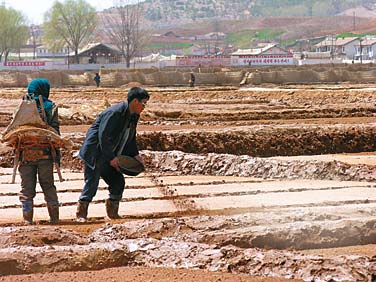
In a country as secretive as North Korea, even natural disasters are shrouded in mystery. International aid groups are struggling to determine the extent of damage caused by July's torrential rains and floods.
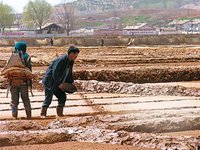 With accurate data hard to come by in the Hermit Kingdom, "we simply don't know and can't know" the extent of the fatalities, says Gerald Bourke, spokesman for the World Food Program in Beijing. Bourke has no doubt, though, that "there are a lot of hungry people" in North Korea right now.
Whatever its scope, international attention on the catastrophe could benefit dictator Kim Jong Il. Seoul, which suspended food shipments after the tests, quickly reversed course, promising $10 million in aid last month.
So far Washington hasn't resumed the food aid it suspended last year. Pyongyang remains equally defiant and shows no signs of returning to talks aimed at ending its nuclear program. Unknown millions of North Koreans might be struggling to survive, but Kim Jong Il is still sitting pretty.
[TIME Asia edition]
 With accurate data hard to come by in the Hermit Kingdom, "we simply don't know and can't know" the extent of the fatalities, says Gerald Bourke, spokesman for the World Food Program in Beijing. Bourke has no doubt, though, that "there are a lot of hungry people" in North Korea right now.
Whatever its scope, international attention on the catastrophe could benefit dictator Kim Jong Il. Seoul, which suspended food shipments after the tests, quickly reversed course, promising $10 million in aid last month.
So far Washington hasn't resumed the food aid it suspended last year. Pyongyang remains equally defiant and shows no signs of returning to talks aimed at ending its nuclear program. Unknown millions of North Koreans might be struggling to survive, but Kim Jong Il is still sitting pretty.
[TIME Asia edition]
Sunday, September 03, 2006
More on Stunted North Koreans
Chronic food shortages and malnutrition have stunted many North Koreans, making some look like dwarfs. Television footage broadcast in South Korea showed gaunt North Koreans scouring winter fields for grains left by reapers.
A 2004 survey of 2,300 North Korean defectors showed that average North Korean men and women are 5.9 centimeter and 4.1 centimeters shorter than their South Korean counterparts, respectively. An average 14-year-old boy from North Korea is up to 15.8 centimeters shorter than the same-aged South Korean.
[Also, concerning clothes sent to North Korea as part of a relief effort] North Korean officials want ... all without English writing on them. Relief workers said, "We pick out any clothing that has English writing on it. North Korean authorities apparently don't want their people to think the clothes are coming from their sworn enemy, the U.S."
[Yonhap News]
A 2004 survey of 2,300 North Korean defectors showed that average North Korean men and women are 5.9 centimeter and 4.1 centimeters shorter than their South Korean counterparts, respectively. An average 14-year-old boy from North Korea is up to 15.8 centimeters shorter than the same-aged South Korean.
[Also, concerning clothes sent to North Korea as part of a relief effort] North Korean officials want ... all without English writing on them. Relief workers said, "We pick out any clothing that has English writing on it. North Korean authorities apparently don't want their people to think the clothes are coming from their sworn enemy, the U.S."
[Yonhap News]
Saturday, September 02, 2006
Relief goods mirror plight of stunted North Koreans
The shipment-in-waiting is for thousands, perhaps tens of thousands of North Koreans who were made homeless in massive floods in mid-July.
Thousands of used but clean shirts, pants and other clothes are stacked in big heaps in warehouses outside Seoul to be sent to poverty-stricken North Korea. After years of dealing with North Korea, South Korean donors have learned that helping the communist country is not just about sending large quantities of supplies. It requires certain "customization."
"The maximum size of clothes we send to North Korea is 'large,'" said Hyun Il-hyun, secretary at Join Together Society, another South Korean relief agency, "We know anything bigger, like 'extra large' or 'extra extra large,' won't fit North Koreans."
"What will fit elementary school kids in South Korea will usually fit North Korean middle-schoolers," she said. "Most North Korean adults will fit well into what South Korean teenagers wear."
[Yonhap News]
Thousands of used but clean shirts, pants and other clothes are stacked in big heaps in warehouses outside Seoul to be sent to poverty-stricken North Korea. After years of dealing with North Korea, South Korean donors have learned that helping the communist country is not just about sending large quantities of supplies. It requires certain "customization."
"The maximum size of clothes we send to North Korea is 'large,'" said Hyun Il-hyun, secretary at Join Together Society, another South Korean relief agency, "We know anything bigger, like 'extra large' or 'extra extra large,' won't fit North Koreans."
"What will fit elementary school kids in South Korea will usually fit North Korean middle-schoolers," she said. "Most North Korean adults will fit well into what South Korean teenagers wear."
[Yonhap News]
Friday, September 01, 2006
Kim Jong-chol, North Korean refugee story
Glancing nervously out a window in this border city, [North Korean refugee] Kim Jong-chol said he'd commit suicide if the police threatened him with repatriation.
"I have no choice if I'm arrested. I can't go back to North Korea now," Kim said, explaining that he'd confront criminal charges, and probably execution, as someone who'd fled to China twice before, been caught both times and forcibly repatriated.
Asked to explain what life is like in his homeland, Kim said quietly: "You will never understand what I'm telling you. It's such a miserable situation." Kim, a farmer, said his family's home had no indoor plumbing. In winter, there was never enough heat. For most people, food supplies are inadequate. The children always ask for more food, Kim said, describing the daily diet as mostly boiled or mashed corn. Electricity was on for three hours a day at most, and the family had to fetch water from far away.
"Rice rations have stopped, and there's no guarantee you can get your wage," Kim said. Any criticism of the regime is kept to very intimate friends or family. "Many people disappear for making the wrong remarks," he said.
Kim said he hoped to reach a safe area outside China, then "I will work like a slave to earn money to bring my wife and children out of North Korea."
[SanLuisOpispo.com]
"I have no choice if I'm arrested. I can't go back to North Korea now," Kim said, explaining that he'd confront criminal charges, and probably execution, as someone who'd fled to China twice before, been caught both times and forcibly repatriated.
Asked to explain what life is like in his homeland, Kim said quietly: "You will never understand what I'm telling you. It's such a miserable situation." Kim, a farmer, said his family's home had no indoor plumbing. In winter, there was never enough heat. For most people, food supplies are inadequate. The children always ask for more food, Kim said, describing the daily diet as mostly boiled or mashed corn. Electricity was on for three hours a day at most, and the family had to fetch water from far away.
"Rice rations have stopped, and there's no guarantee you can get your wage," Kim said. Any criticism of the regime is kept to very intimate friends or family. "Many people disappear for making the wrong remarks," he said.
Kim said he hoped to reach a safe area outside China, then "I will work like a slave to earn money to bring my wife and children out of North Korea."
[SanLuisOpispo.com]
Thursday, August 31, 2006
North Korean refugees living in fear in China
China may be far freer than North Korea, but it's a perilous way station for North Korean refugees who flee hunger and darkness in their homeland. Branded as illegal immigrants and subject to arrest and deportation, some dwell in hidden work camps or caves. Others scrounge for food in the hinterlands.
Most hope to hook into a fragile underground railroad that will take them to safety in Mongolia or Southeast Asia, further stops before eventual resettlement in South Korea or even America.
But as the refugees dream of leaving China, often with the help of good Samaritans from South Korea, the United States and Japan, they live in dread of capture.
"They have no rights. They are living in daily fear. ... They have no protection under the laws of China," said Sam Kim, the general counsel of the Korean Church Coalition for North Korean Freedom, an advocacy group based in Southern California.
North Korean women and girls are particularly vulnerable. If Chinese farmers catch them, they're often forced into the sex trade or sold as rural brides.
[SanLuisObispo.com]
Most hope to hook into a fragile underground railroad that will take them to safety in Mongolia or Southeast Asia, further stops before eventual resettlement in South Korea or even America.
But as the refugees dream of leaving China, often with the help of good Samaritans from South Korea, the United States and Japan, they live in dread of capture.
"They have no rights. They are living in daily fear. ... They have no protection under the laws of China," said Sam Kim, the general counsel of the Korean Church Coalition for North Korean Freedom, an advocacy group based in Southern California.
North Korean women and girls are particularly vulnerable. If Chinese farmers catch them, they're often forced into the sex trade or sold as rural brides.
[SanLuisObispo.com]
Wednesday, August 30, 2006
Phillip Buck: "My work is nowhere near finished."
For the last 15 months, Phillip Buck, 69, an evangelical pastor from Seattle, Washington sat in a jail cell in northeastern China his health deteriorating, not knowing when—or even if—he would get out and see his family in the U.S. again.
Now he is free. Buck had been a key member of the so-called underground railroad that moves refugees from North Korea through China to safety in South Korea.
Buck told TIME, "I did nothing wrong. All I was doing was helping the [North Korean] refugees." Buck had devoted his ministry since 1997 to the cause of aiding North Koreans.
"They [the Chinese authorities] had been after me ever since 2002," Buck says. His sentence includes a ban from ever going back to China, but Buck says he still has a network of people in the country helping run the underground railroad, and he will now figure out ways to help them from afar, in part by raising money to house and feed North Korean refugees in China.
"Every day in prison--457 days—I thought about the refugees and prayed to God to help them. My work is nowhere near finished."
[Excerpted from TIME magazine]
Now he is free. Buck had been a key member of the so-called underground railroad that moves refugees from North Korea through China to safety in South Korea.
Buck told TIME, "I did nothing wrong. All I was doing was helping the [North Korean] refugees." Buck had devoted his ministry since 1997 to the cause of aiding North Koreans.
"They [the Chinese authorities] had been after me ever since 2002," Buck says. His sentence includes a ban from ever going back to China, but Buck says he still has a network of people in the country helping run the underground railroad, and he will now figure out ways to help them from afar, in part by raising money to house and feed North Korean refugees in China.
"Every day in prison--457 days—I thought about the refugees and prayed to God to help them. My work is nowhere near finished."
[Excerpted from TIME magazine]
Tuesday, August 29, 2006
U.S. to accept 30 North Korean refugees
About 30 North Korean defectors are seeking asylum in the United States, Radio Free Asia quoted a mission leader working with refugees as saying yesterday.
 In an interview with the Washington-based news channel, Rev. Cheon Ki-won of Durihana Mission said, "A second group of North Korean defectors will soon be entering the United States following the first six in May."
"The number of (N.K. defectors) will be around 25 to 30," Cheon said. He said he was not sure whether they would be arriving in the United States together or separately.
The North Korean defectors can by law seek asylum in the United States based under the 2004 U.S. law promoting and assisting human rights in North Korea.
Explaining how Ellen Sauerbrey, the assistant secretary of state for population, refugees and migration, is currently in Southeast Asia, Cheon said he hoped to see an early solution to the latest group of North Koreans.
Speaking in an interview with RFA last week, U.S. Special Envoy on Human Rights in North Korea Jay Lefkowitz said the United States is a "safe haven for refugees fleeing the despotism of North Korea."
"We are looking to help facilitate the passage of North Korean refugees into freedom. And to the extent that North Korean refugees would like to come to the United States, that is something that we want to make available," he was quoted as saying.
[The Korean Herald]
 In an interview with the Washington-based news channel, Rev. Cheon Ki-won of Durihana Mission said, "A second group of North Korean defectors will soon be entering the United States following the first six in May."
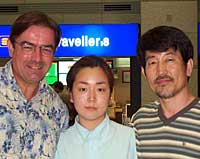
 Photo caption: Tim Peters greets Cheon Ki-won at airport, after Cheon's release from a Chinese prison. [Also pictured in this file photo, Cheon's daughter, Hanah.]
"The number of (N.K. defectors) will be around 25 to 30," Cheon said. He said he was not sure whether they would be arriving in the United States together or separately.
The North Korean defectors can by law seek asylum in the United States based under the 2004 U.S. law promoting and assisting human rights in North Korea.
Explaining how Ellen Sauerbrey, the assistant secretary of state for population, refugees and migration, is currently in Southeast Asia, Cheon said he hoped to see an early solution to the latest group of North Koreans.
Speaking in an interview with RFA last week, U.S. Special Envoy on Human Rights in North Korea Jay Lefkowitz said the United States is a "safe haven for refugees fleeing the despotism of North Korea."
"We are looking to help facilitate the passage of North Korean refugees into freedom. And to the extent that North Korean refugees would like to come to the United States, that is something that we want to make available," he was quoted as saying.
[The Korean Herald]
North Korean Defectors Pose Growing Challenge
The slow exodus of North Koreans from their impoverished homeland is posing increasingly vexing diplomatic problems for China and South Korea, as they grapple with their Stalinist neighbor's decay.
Beijing sees the North Koreans as illegal economic migrants, subject to repatriation.
Seoul is worried about the flow, fearing the situation is jeopardizing its efforts to improve relations with Pyongyang.
Tim Peters, the founder of Helping Hands Korea, a nongovernmental organization that raises funds for clandestine operations to move refugees out of China, says … many South Koreans seemed to regard defectors as a costly social nuisance.
Peters commented that if in the future, the international community is remembered as doing more than South Korea has when it comes to helping refugees from the North, "that's going to be a horrible scar on the consciences of their [South Korean] grandchildren."
Beijing sees the North Koreans as illegal economic migrants, subject to repatriation.
Seoul is worried about the flow, fearing the situation is jeopardizing its efforts to improve relations with Pyongyang.
Tim Peters, the founder of Helping Hands Korea, a nongovernmental organization that raises funds for clandestine operations to move refugees out of China, says … many South Koreans seemed to regard defectors as a costly social nuisance.
Peters commented that if in the future, the international community is remembered as doing more than South Korea has when it comes to helping refugees from the North, "that's going to be a horrible scar on the consciences of their [South Korean] grandchildren."
Monday, August 28, 2006
The hidden exodus from North Korea
The hidden exodus from North Korea has unfolded for more than a decade. In past years, refugees coming across the border knew little of China. But since China has repatriated large numbers of North Koreans, probably in the tens of thousands, those who wish to escape now have information before they go.
"When they cross over the border now, they always have some knowledge: which route to go, daytime or nighttime, which villages to avoid, which churches to go to," said a South Korean activist, who spoke on the condition of anonymity because China could imprison him for his campaign to help refugees.
The activist said refugees now moved as far inland in China as possible, sometimes living for years with the help of ethnic Koreans in northeast China or South Korean businessmen in populous coastal Shandong province or around Shanghai.
Until this year, the United States accepted only high-level defectors from North Korea, not common refugees. But under the terms of the 2004 North Korean Human Rights Act, Washington opened the doors to refugees. Six entered the United States in May; three others arrived in late July.
Maybe half the North Koreans hiding in China want to remain there, said Tim A. Peters, founder of Helping Hands Korea, a Seoul-based group that assists the refugees.
"The other half have set their sights on a distant horizon, either South Korea or the U.S. or elsewhere," Peters said.
[SanLuisOpispo.com]
"When they cross over the border now, they always have some knowledge: which route to go, daytime or nighttime, which villages to avoid, which churches to go to," said a South Korean activist, who spoke on the condition of anonymity because China could imprison him for his campaign to help refugees.
The activist said refugees now moved as far inland in China as possible, sometimes living for years with the help of ethnic Koreans in northeast China or South Korean businessmen in populous coastal Shandong province or around Shanghai.
Until this year, the United States accepted only high-level defectors from North Korea, not common refugees. But under the terms of the 2004 North Korean Human Rights Act, Washington opened the doors to refugees. Six entered the United States in May; three others arrived in late July.
Maybe half the North Koreans hiding in China want to remain there, said Tim A. Peters, founder of Helping Hands Korea, a Seoul-based group that assists the refugees.
"The other half have set their sights on a distant horizon, either South Korea or the U.S. or elsewhere," Peters said.
[SanLuisOpispo.com]
Sunday, August 27, 2006
Thailand friendly haven for North Korean refugees
[Including the 175 North Korean refugees apprehended in Thailand on August 22] local sources say Thailand is currently home to 260 North Korean defectors.
The Thai government has turned a blind eye to North Korean defectors’ illegal entry and their entry to a third country because of humanitarian reasons. Also, it maintains good relations with the Korean and U.S. governments, the defectors’ final destination.
A diplomatic source in Thailand said, “The number of North Koreans who sneak out of China to Thailand through Laos is rapidly increasing.”
The Thai authorities feel the burden of the increasing number of North Korean defectors, however. “Rumor has it that 100,000 defectors in China plan to enter Thailand through a neighboring country, which I think is very serious,” said Lt. Gen. Suwat Tumrongsiskul.
[Dong-A Ilbo]
Most North Koreans who manage to leave their tightly controlled country do so across the border into a region of northeast China populated by ethnic Koreans. Some have managed to cross China to Thailand and Vietnam in recent years and most are sent on to Seoul, often without publicity to avoid upsetting the North Korean government.
[Reuters]
The Thai government has turned a blind eye to North Korean defectors’ illegal entry and their entry to a third country because of humanitarian reasons. Also, it maintains good relations with the Korean and U.S. governments, the defectors’ final destination.
A diplomatic source in Thailand said, “The number of North Koreans who sneak out of China to Thailand through Laos is rapidly increasing.”
The Thai authorities feel the burden of the increasing number of North Korean defectors, however. “Rumor has it that 100,000 defectors in China plan to enter Thailand through a neighboring country, which I think is very serious,” said Lt. Gen. Suwat Tumrongsiskul.
[Dong-A Ilbo]
Most North Koreans who manage to leave their tightly controlled country do so across the border into a region of northeast China populated by ethnic Koreans. Some have managed to cross China to Thailand and Vietnam in recent years and most are sent on to Seoul, often without publicity to avoid upsetting the North Korean government.
[Reuters]
Saturday, August 26, 2006
Pressure on the South Korea - North Korea Relations
The South Korean government is watching the recent development [of 175 North Korean refugees apprehended in Thailand] closely, predicting how the North Korean regime will respond to most of the defectors’ wanting to come to the South, since the already strained relation between the two Koreans after the North’s missile launches might worsen.
After 460 North Korean defectors came to South Korea en masse from Vietnam in July 2004, North Korea protested, suspending contact between the authorities for 10 months.
The number of North Korean defectors to South Korea goes up every year. The number from January to July of this year now stands at 1,054, up 59 percent from the same period last year.
[Dong-A Ilbo]
Departure of North Korean refugees delayed
The departure of 18 North Korean refugees bound for Seoul, having been found hiding in Bangkok, has been delayed due to security concerns.
The 18 were among 175 North Koreans held by Thai authorities earlier this week while hiding in an abandoned house in Bangkok. Police believe they entered the country from the northern border with Myanmar two months ago.
A Thai court convicted most of the adult North Koreans of illegal entry and fined them 6,000 baht (160 dollars). None were able to pay, and were sentenced to 30 days in prison.
[AFP]
The 18 were among 175 North Koreans held by Thai authorities earlier this week while hiding in an abandoned house in Bangkok. Police believe they entered the country from the northern border with Myanmar two months ago.
A Thai court convicted most of the adult North Koreans of illegal entry and fined them 6,000 baht (160 dollars). None were able to pay, and were sentenced to 30 days in prison.
[AFP]
Friday, August 25, 2006
North Korean refugees in Thailand not returning to NK
Thai police have charged nearly 200 North Korean asylum seekers who were smuggled into the country with illegal entry, but will not forcibly deport them to their home country, officials said.
If the court rules that they entered illegally, they will be deported, chief of immigration police, Lt. Gen. Suwat Tumrongsiskul said. However, they will not be forced to return to North Korea and authorities will consult with humanitarian organizations to determine where they should be sent, he said.
They had entered Thailand in separate groups through the northern Thai province of Chiang Rai, and had been staying in the two-story house for the past two months.
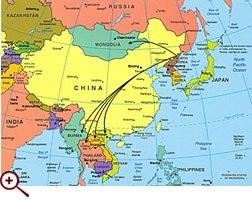 Thousands of North Koreans, facing hunger and repression in their homeland, have made their way abroad in recent years, many taking a long and risky land journey through China to arrive in Thailand, Vietnam, Cambodia and other Southeast Asian countries.
[The Korean Herald]
If the court rules that they entered illegally, they will be deported, chief of immigration police, Lt. Gen. Suwat Tumrongsiskul said. However, they will not be forced to return to North Korea and authorities will consult with humanitarian organizations to determine where they should be sent, he said.
They had entered Thailand in separate groups through the northern Thai province of Chiang Rai, and had been staying in the two-story house for the past two months.
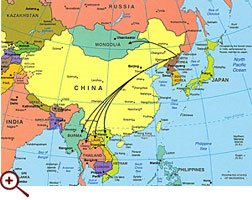 Thousands of North Koreans, facing hunger and repression in their homeland, have made their way abroad in recent years, many taking a long and risky land journey through China to arrive in Thailand, Vietnam, Cambodia and other Southeast Asian countries.
[The Korean Herald]
Thursday, August 24, 2006
More on North Korean Refugees Arrested in Thailand
Thailand has become a haven for North Koreans who flee their country on an "underground railroad" via China to Southeast Asia -- often undergoing harrowing experiences along the way.
Says Tim Peters, a U.S. Christian activist who heads up the charity Helping Hands Korea,
"Thailand, because of its history and experience dealing with refugees from Cambodia, Burma and elsewhere, deals responsibly with refugees, and there is a regional office of the UNHCR in Bangkok."
Mr. Peters was featured on the cover of Time magazine's Asian edition in May for his work helping North Korean refugees.
Asked how many have fled North Korea, Mr. Peters said it is difficult to say. "It is almost anyone's guess, but I would multiply State Department figures of [30,000] to 50,000 by 10," he said.
He cited food shortages and the aftermath of disastrous flooding last month as "push factors" driving North Koreans out of their land, adding that China has recently deployed 2,000 extra troops to seal its border with North Korea.
[Excerpt of article by Andrew Salmon, The Washington Times]
Says Tim Peters, a U.S. Christian activist who heads up the charity Helping Hands Korea,
"Thailand, because of its history and experience dealing with refugees from Cambodia, Burma and elsewhere, deals responsibly with refugees, and there is a regional office of the UNHCR in Bangkok."
Mr. Peters was featured on the cover of Time magazine's Asian edition in May for his work helping North Korean refugees.
Asked how many have fled North Korea, Mr. Peters said it is difficult to say. "It is almost anyone's guess, but I would multiply State Department figures of [30,000] to 50,000 by 10," he said.
He cited food shortages and the aftermath of disastrous flooding last month as "push factors" driving North Koreans out of their land, adding that China has recently deployed 2,000 extra troops to seal its border with North Korea.
[Excerpt of article by Andrew Salmon, The Washington Times]
Thai police arrest 175 North Koreans
 Thailand's police rounded up 175 North Korean defectors -- mainly women and children -- in a raid on a Bangkok suburb Tuesday, an incident that has cast light on the Southeast Asian nation's increasingly popular status as a refuge for defectors from Kim Jong-il's regime.
The refugees had escaped North Korea via China and are thought to have been awaiting processing by the United Nations High Commissioner for Refugees (UNHCR), and the South Korean and possibly U.S. embassies, before transit to a third country.
A Seoul official familiar with North Korea-related issues said: "We do not believe this marks a change in Thai policy. They have said that they will release them to third countries -- South Korea or the United States -- after interrogation. I don't think they are going to send them back to North Korea."
Activists urged more action. "Governments have to deal with this and look this crisis in the face," said Tim Peters, a U.S. Christian activist who heads up the charity Helping Hands Korea. "Hopefully, the main players are going to start looking at ways they can absorb more of these refugees."
[Excerpt of article by Andrew Salmon, The Washington Times]
Wednesday, August 23, 2006
Korean Missionary Phillip Jun Buck, rescuer of North Korean refugees
The following is an excerpt from Tim Peters’ 2005 testimony before the House Committee on International Relations:
As was the case when I was invited to appear before the International Relations Committee, first in May of 2002, then again in April of 2004, I would like to give prominent place to the fellow activists who have sacrificed so much in rescuing North Korean refugees. … I would like to emphasize one case in particular today. This year the arrow of misfortune has struck closer to home. Fellow American, Pastor Phillip Jun Buck, aged 68, was detained in May of this year in his courageous work of sheltering and protecting North Korean refugees.
I am mentioning Pastor Buck in part because I have the privilege of knowing him personally and cherish the honor of being among the supporters of his refugee shelters in recent years. Phillip Buck would appear quietly and unannounced at our weekly Catacomb meetings in Seoul. He would then share uplifting testimonies from his refugee shelters in China. Particularly worrisome to his family and loved ones, Pastor Buck suffers from severe sleep disorders that stem from an auto accident in Russia years ago, and which pose particular hardships under prison conditions in China.
I would ask, Gentlemen, that just as you exerted such swift and critical influence with the Chinese government that resulted in the release of Chun Ki Won in August of 2002, that you would give equal attention and commitment to the unjust and harsh imprisonment of fellow American Pastor Phillip Jun Buck. His case is particularly urgent as the bitterly cold winter of northeastern China is very nigh.
Full transcript
As was the case when I was invited to appear before the International Relations Committee, first in May of 2002, then again in April of 2004, I would like to give prominent place to the fellow activists who have sacrificed so much in rescuing North Korean refugees. … I would like to emphasize one case in particular today. This year the arrow of misfortune has struck closer to home. Fellow American, Pastor Phillip Jun Buck, aged 68, was detained in May of this year in his courageous work of sheltering and protecting North Korean refugees.
I am mentioning Pastor Buck in part because I have the privilege of knowing him personally and cherish the honor of being among the supporters of his refugee shelters in recent years. Phillip Buck would appear quietly and unannounced at our weekly Catacomb meetings in Seoul. He would then share uplifting testimonies from his refugee shelters in China. Particularly worrisome to his family and loved ones, Pastor Buck suffers from severe sleep disorders that stem from an auto accident in Russia years ago, and which pose particular hardships under prison conditions in China.
I would ask, Gentlemen, that just as you exerted such swift and critical influence with the Chinese government that resulted in the release of Chun Ki Won in August of 2002, that you would give equal attention and commitment to the unjust and harsh imprisonment of fellow American Pastor Phillip Jun Buck. His case is particularly urgent as the bitterly cold winter of northeastern China is very nigh.
Full transcript
Korean-American missionary home after 15 months in Chinese prison
A missionary who was imprisoned for 15 months after trying to aid North Korean refugees in China has returned home to a greeting of balloons and flowers from delighted relatives and friends.
Wearing a baseball hat and dark sunglasses Monday night on his arrival at Seattle-Tacoma International Airport, the Rev. Phillip Jun Buck, 68, said returning home was like being in a "dream state."
A son, Jamin Yoon, 35, holding flowers as his father was swarmed by reporters, said his father's attire was chosen to shield his appearance in case the longtime evangelist decided to try to go back to China for more missionary work.
Buck, who provided shelter and work for North Koreans in northeastern China, was convicted in December of trying to sneak North Korean refugees through China into South Korea. He could have faced up to 20 years in prison but was sentenced recently to deportation and a ban on re-entry to China.
Although activists concerned with religious freedom agitated openly for Buck's release, his four adult children shunned publicity while pressing for action from Congress and government agencies. His case was raised at a congressional subcommittee hearing in April.
[Associated Press]
Wearing a baseball hat and dark sunglasses Monday night on his arrival at Seattle-Tacoma International Airport, the Rev. Phillip Jun Buck, 68, said returning home was like being in a "dream state."
A son, Jamin Yoon, 35, holding flowers as his father was swarmed by reporters, said his father's attire was chosen to shield his appearance in case the longtime evangelist decided to try to go back to China for more missionary work.
Buck, who provided shelter and work for North Koreans in northeastern China, was convicted in December of trying to sneak North Korean refugees through China into South Korea. He could have faced up to 20 years in prison but was sentenced recently to deportation and a ban on re-entry to China.
Although activists concerned with religious freedom agitated openly for Buck's release, his four adult children shunned publicity while pressing for action from Congress and government agencies. His case was raised at a congressional subcommittee hearing in April.
[Associated Press]
Imprisoned Korean-American missionary to return from China
A Korean-American missionary, imprisoned in China on charges of trying to smuggle North Korean refugees into South Korea, has been sentenced to deportation, his congregation has been told.The Rev. Phillip Jun Buck, 68, whose case was widely cited by activists concerned with religious freedom in North Korea, should be back home shortly.
"He's OK," said Senior Pastor Chang Cheh, adding that he had spoken by telephone with his fellow seminarian and colleague of nearly 40 years.
Buck was trying to help refugees who fled to northeast China from hunger and repression in North Korea when he was arrested in May 2005 and incarcerated in Yanji. He was convicted in December of trying to smuggle North Korean refugees though China into South Korea. Facing as much as 20 years in prison, he was instead deported and banned from returning to China.
Buck fled his home and family in North Korea as a child, never forgot his roots and wanted to improve the lot of his homeland, said his youngest daughter, Grace Yoon, 30, who translates Korean sermons into English at the church.
He built several shelters in China, and ran a noodle factory in North Korea for a year, starting in 1997, feeding thousands of hungry people until government officials became suspicious and forced him to leave in 1998, Yoon said.It was after that eviction that he decided to take his efforts to China, she said."He's very passionate about helping North Korean refugees," she said. "He would just give everything for them."
[The Daily News of Longview, Washington]
"He's OK," said Senior Pastor Chang Cheh, adding that he had spoken by telephone with his fellow seminarian and colleague of nearly 40 years.
Buck was trying to help refugees who fled to northeast China from hunger and repression in North Korea when he was arrested in May 2005 and incarcerated in Yanji. He was convicted in December of trying to smuggle North Korean refugees though China into South Korea. Facing as much as 20 years in prison, he was instead deported and banned from returning to China.
Buck fled his home and family in North Korea as a child, never forgot his roots and wanted to improve the lot of his homeland, said his youngest daughter, Grace Yoon, 30, who translates Korean sermons into English at the church.
He built several shelters in China, and ran a noodle factory in North Korea for a year, starting in 1997, feeding thousands of hungry people until government officials became suspicious and forced him to leave in 1998, Yoon said.It was after that eviction that he decided to take his efforts to China, she said."He's very passionate about helping North Korean refugees," she said. "He would just give everything for them."
[The Daily News of Longview, Washington]
Tuesday, August 22, 2006
Gadhafi urged North Korea to give up nuclear weapons
Libyan leader Moammar Gadhafi told a visiting Japanese official that his country has urged North Korea to give up efforts to develop weapons of mass destruction, the Foreign Ministry said.
Iwao Matsuda, Japan's state minister for science and technology policy, held talks with Gadhafi in Sebha, about 375 miles south of Tripoli, the ministry said in a statement issued Friday.
Gadhafi surprised the world in late 2003 when he swore off terrorism and announced plans to dismantle his country's weapons of mass destruction programs. Libya was eager to end his international isolation and economic hardships from United Nations and U.S. sanctions, and Gadhafi concluded the weapons programs were best used as a bargaining chip.
Gadhafi told Matsuda that Libya has been urging North Korea to follow his country's example and called for cooperation from developed countries including Japan in persuading Pyongyang, the ministry said.
[Associated Press]
Iwao Matsuda, Japan's state minister for science and technology policy, held talks with Gadhafi in Sebha, about 375 miles south of Tripoli, the ministry said in a statement issued Friday.
Gadhafi surprised the world in late 2003 when he swore off terrorism and announced plans to dismantle his country's weapons of mass destruction programs. Libya was eager to end his international isolation and economic hardships from United Nations and U.S. sanctions, and Gadhafi concluded the weapons programs were best used as a bargaining chip.
Gadhafi told Matsuda that Libya has been urging North Korea to follow his country's example and called for cooperation from developed countries including Japan in persuading Pyongyang, the ministry said.
[Associated Press]
Monday, August 21, 2006
Former Generals on Talking to North Korea
Twenty-one former generals and high ranking national security officials have called on United States President George W. Bush to reverse course and embrace a new area of negotiation with Iran, Iraq, and North Korea. In a letter, the group told reporters Bush's 'hard line' policies have undermined national security and made America less safe.
In a telephone news conference, the former security officials took particular aim at the Bush Administration's policy of refusing to negotiate with terrorists or with states that support them. "That seems strange since Ronald Reagan was willing to negotiate with the Soviets even though they were the 'Evil Empire," said retired Lt. General Robert Guard, who served as special assistant to Defense Secretary Robert McNamara during the Vietnam War.
"When you announce an axis of evil of three countries and invade one and then say that [others] should take that as a lesson, it does seem that it may give them an incentive to do precisely what they don't want them to do," Guard said.
Former director of Policy Planning for the State Department, Morton Halperin, said … the more belligerent the Bush Administration behaves, the faster North Korea will work to develop nuclear weapons. "
The North Koreans want to talk to us directly," said Halperin, who now works for the Washington, DC-based Center for American Progress. "Their concern is about getting security assurances from us and about getting diplomatic recognition. We should not be afraid to talk to our opponents."
In a telephone news conference, the former security officials took particular aim at the Bush Administration's policy of refusing to negotiate with terrorists or with states that support them. "That seems strange since Ronald Reagan was willing to negotiate with the Soviets even though they were the 'Evil Empire," said retired Lt. General Robert Guard, who served as special assistant to Defense Secretary Robert McNamara during the Vietnam War.
"When you announce an axis of evil of three countries and invade one and then say that [others] should take that as a lesson, it does seem that it may give them an incentive to do precisely what they don't want them to do," Guard said.
Former director of Policy Planning for the State Department, Morton Halperin, said … the more belligerent the Bush Administration behaves, the faster North Korea will work to develop nuclear weapons. "
The North Koreans want to talk to us directly," said Halperin, who now works for the Washington, DC-based Center for American Progress. "Their concern is about getting security assurances from us and about getting diplomatic recognition. We should not be afraid to talk to our opponents."
Saturday, August 19, 2006
North Korea: The Orwellian Paradise
Following are excerpts of the travelogue of a young American, “The Savvy Traveler”, who traveled to North Korea:
The North Korean capital Pyongyang is a city of monuments; statues to Kim Il-Sung (the country’s founder) and various revolutionary ideals abound. There is not much vehicular traffic, as few North Koreans can afford bicycles, let alone cars. There really isn’t much need for cars anyway, since travel between cities is forbidden without a permit.
Juche is the Korean philosophy of self-reliance. It is an important part of the ideology of control developed by Kim Il-Sung. To give you an idea of the personality cult in the DPRK, just before the guides took us there we went to a flower exhibition. The Koreans renamed two common flowers to the Kim Il-Sungia and the Kim Jong-Ilia. How's that for Big Brother?
We glimpsed a military parade in the center of town, with thousands of flag-waiving North Koreans lining the streets to greet their soldiers, who will defend them from the American invasion that the regime constantly talks warns of. Defining the United States as a powerful and common enemy is one of the many levers of control the regime uses to unite the people and maintain its ironclad grip on power.
The North Koreans seem to have a flair for dramatic monuments, and so built themselves their own Arc de Triomphe. Theirs is actually a little taller than the one in Paris. Nearby the Arc was an amusement park, which was the only place the group was able to mix fairly freely with regular North Korean citizens. North Korean children played the same types of games American kids do, only they shoot at U.S. Marines instead of rabbits and clowns.
The North Korean capital Pyongyang is a city of monuments; statues to Kim Il-Sung (the country’s founder) and various revolutionary ideals abound. There is not much vehicular traffic, as few North Koreans can afford bicycles, let alone cars. There really isn’t much need for cars anyway, since travel between cities is forbidden without a permit.
Juche is the Korean philosophy of self-reliance. It is an important part of the ideology of control developed by Kim Il-Sung. To give you an idea of the personality cult in the DPRK, just before the guides took us there we went to a flower exhibition. The Koreans renamed two common flowers to the Kim Il-Sungia and the Kim Jong-Ilia. How's that for Big Brother?
We glimpsed a military parade in the center of town, with thousands of flag-waiving North Koreans lining the streets to greet their soldiers, who will defend them from the American invasion that the regime constantly talks warns of. Defining the United States as a powerful and common enemy is one of the many levers of control the regime uses to unite the people and maintain its ironclad grip on power.
The North Koreans seem to have a flair for dramatic monuments, and so built themselves their own Arc de Triomphe. Theirs is actually a little taller than the one in Paris. Nearby the Arc was an amusement park, which was the only place the group was able to mix fairly freely with regular North Korean citizens. North Korean children played the same types of games American kids do, only they shoot at U.S. Marines instead of rabbits and clowns.
Friday, August 18, 2006
North Korea preparing for test of nuclear bomb?
There is new evidence that North Korea may be preparing for an underground test of a nuclear bomb, U.S. officials told ABC News.
“It is the view of the intelligence community that a test is a real possibility,” said a senior State Department official.
A senior military official told ABC News that a U.S. intelligence agency has recently observed “suspicious vehicle movement” at a suspected North Korean test site.
The activity includes the unloading of large reels of cable outside P’unggye-yok, an underground facility in northeast North Korea. Cables can be used in nuclear testing to connect an underground test site to outside observation equipment.
[ABC News]
“It is the view of the intelligence community that a test is a real possibility,” said a senior State Department official.
A senior military official told ABC News that a U.S. intelligence agency has recently observed “suspicious vehicle movement” at a suspected North Korean test site.
The activity includes the unloading of large reels of cable outside P’unggye-yok, an underground facility in northeast North Korea. Cables can be used in nuclear testing to connect an underground test site to outside observation equipment.
[ABC News]
Thursday, August 17, 2006
North Korean Death Toll approaching 60,000?
North Korea has accepted aid from South Korea to help recover from floods that an aid group claims left tens of thousands dead and more than 2 million homeless, a South Korean official said.
It is an apparent turnabout for the impoverished communist country, which spurned aid from South Korea's Red Cross after the floods hit in mid-July, saying it would handle the disaster on its own.
Meanwhile, the Seoul-based private aid agency Good Friends raised its death toll estimate Thursday to 57,700, up 3,000 from its earlier figures.
Good Friends said it has 'many sources' inside North Korea but did not say where it obtained the figures, which could not be independently confirmed because the North tightly controls all media and information. Good Friends refused to elaborate on the report, saying their sources could face government reprisals.
The agency's previous reports of activities inside the isolated country have been confirmed by South Korean government sources, although some of the aid group's figures have been disputed.
Good Friends said the floods destroyed more than 230 bridges and inundated hundreds of thousands of acres of farmland, further straining the North's ability to feed its population.
Good Friends said it would take up to three years for the North to recover from the disaster without international aid, and starvation similar to that during the 1990s might strike the North again within that time.
'Food prices are skyrocketing as food distribution has become nearly impossible' due to the floods, the group said.
[Associated Press]
It is an apparent turnabout for the impoverished communist country, which spurned aid from South Korea's Red Cross after the floods hit in mid-July, saying it would handle the disaster on its own.
Meanwhile, the Seoul-based private aid agency Good Friends raised its death toll estimate Thursday to 57,700, up 3,000 from its earlier figures.
Good Friends said it has 'many sources' inside North Korea but did not say where it obtained the figures, which could not be independently confirmed because the North tightly controls all media and information. Good Friends refused to elaborate on the report, saying their sources could face government reprisals.
The agency's previous reports of activities inside the isolated country have been confirmed by South Korean government sources, although some of the aid group's figures have been disputed.
Good Friends said the floods destroyed more than 230 bridges and inundated hundreds of thousands of acres of farmland, further straining the North's ability to feed its population.
Good Friends said it would take up to three years for the North to recover from the disaster without international aid, and starvation similar to that during the 1990s might strike the North again within that time.
'Food prices are skyrocketing as food distribution has become nearly impossible' due to the floods, the group said.
[Associated Press]
Wednesday, August 16, 2006
S. Korea Red Cross plans massive rice aid for North Korea
South Korea's Red Cross can give as much as 100,000 tonnes of rice to flood-ravaged North Korea in a one-time aid package, its president said on Monday.
Han Wan-sang said in an interview with KBS radio he hoped South and North Korean Red Cross officials would hold talks soon about the aid plan so that shipments can begin next week. When asked whether that would include as much as 100,000 tonnes of rice, Han said: "Yes, that would be a basis."
Three major storms hit North Kora last month, causing floods that killed [hundreds]. The flooding damaged farms and experts said the loss of crops could push the state, which already battles food shortages, to famine. The extent of the damage is not known because the secretive North Korea has limited inspections by aid groups.
[Yahoo Asia News]
Han Wan-sang said in an interview with KBS radio he hoped South and North Korean Red Cross officials would hold talks soon about the aid plan so that shipments can begin next week. When asked whether that would include as much as 100,000 tonnes of rice, Han said: "Yes, that would be a basis."
Three major storms hit North Kora last month, causing floods that killed [hundreds]. The flooding damaged farms and experts said the loss of crops could push the state, which already battles food shortages, to famine. The extent of the damage is not known because the secretive North Korea has limited inspections by aid groups.
[Yahoo Asia News]
Tuesday, August 15, 2006
US$60 million in relief aid to North Korea
The South Korean government plans to provide tens of billions of won worth of food and supplies to communist North Korea to help repair damage from recent flooding there, government officials said.
The government has already decided to provide some 10 billion won (US$10.3 million) to the country's civic organizations in order to send emergency relief supplies to the flood-hit North, and it is expected to spend another 50 billion won to ensure rice and other supplies are sent as part of a separate project.
"The government decided to join the efforts (by civic organizations) to help repair flood damage in the North after considering the seriousness of the flood damage and requests from various sectors of the society," Vice Unification Minister Shin Un-sang told a press briefing.
[Yonhap News]
The government has already decided to provide some 10 billion won (US$10.3 million) to the country's civic organizations in order to send emergency relief supplies to the flood-hit North, and it is expected to spend another 50 billion won to ensure rice and other supplies are sent as part of a separate project.
"The government decided to join the efforts (by civic organizations) to help repair flood damage in the North after considering the seriousness of the flood damage and requests from various sectors of the society," Vice Unification Minister Shin Un-sang told a press briefing.
[Yonhap News]
Monday, August 14, 2006
North Korea's Kim Jong Il finally appears
North Korean leader Kim Jong Il has made his first public appearance since his country test-launched a barrage of missiles more than a month ago, official media reported Sunday.
Kim visited a farm run by an army unit and was accompanied by top generals, according to the state-run Korean Central News Agency. As usual with such reports, the exact time or location of the trip were not given.
Kim's absence from public view had fueled speculation of a possible crisis in the country in the wake of the missile tests and international reaction.
However, Kim has dropped from sight before for longer periods of time: In 2003, he was not reported to have ventured out for seven weeks after the country quit the Nuclear Nonproliferation Treaty and the United States moved toward invading Iraq.
Some North Korea watchers have speculated that Kim might have been in a bunker, since the country is believed to have imposed a quasi-war footing after the U.N. Security Council passed a resolution condemning the missile tests and calling for nations to stop any missile-related trade with it.
Cheong Seong-chang, a North Korea analyst at the independent Sejong Institute, attributed Kim's latest absence to massive floods in North Korea, saying he has shied away from the public in times of crisis in the past.
[Associated Press]
Kim visited a farm run by an army unit and was accompanied by top generals, according to the state-run Korean Central News Agency. As usual with such reports, the exact time or location of the trip were not given.
Kim's absence from public view had fueled speculation of a possible crisis in the country in the wake of the missile tests and international reaction.
However, Kim has dropped from sight before for longer periods of time: In 2003, he was not reported to have ventured out for seven weeks after the country quit the Nuclear Nonproliferation Treaty and the United States moved toward invading Iraq.
Some North Korea watchers have speculated that Kim might have been in a bunker, since the country is believed to have imposed a quasi-war footing after the U.N. Security Council passed a resolution condemning the missile tests and calling for nations to stop any missile-related trade with it.
Cheong Seong-chang, a North Korea analyst at the independent Sejong Institute, attributed Kim's latest absence to massive floods in North Korea, saying he has shied away from the public in times of crisis in the past.
[Associated Press]
Sunday, August 13, 2006
China Fencing Border With North Korea
China has been building wire fences along its border with North Korea, around the source of the Duman River near Mt. Baekdu. Speculation is that they are meant to prevent defection of North Koreans to China.
The wire fences are 1.5 to 1.7 meters high and two to three meters wide T-shaped concrete pillars, similar to those along the Military Demarcation Line on the Korean peninsular.
Beijing reportedly claimed that the fence is there to stop North Korean defection. This view is widely held as many North Koreans pass the areas near Mt. Baekdu and the Duman River to flee their country.
The border fencing [may also have] something to do with the recent Sino-DPRK relations estranged by Pyongyang’s missile tests.
[donga.com]
The wire fences are 1.5 to 1.7 meters high and two to three meters wide T-shaped concrete pillars, similar to those along the Military Demarcation Line on the Korean peninsular.
Beijing reportedly claimed that the fence is there to stop North Korean defection. This view is widely held as many North Koreans pass the areas near Mt. Baekdu and the Duman River to flee their country.
The border fencing [may also have] something to do with the recent Sino-DPRK relations estranged by Pyongyang’s missile tests.
[donga.com]
Saturday, August 12, 2006
Stark differences between China and North Korea
Chinese tourists who come to Dandong, the border city with North Korea often hop on boats for excursions to a virtual human zoo: They cross the Yalu River and motor along the other side to gawk at poor North Koreans.
On the Chinese side, high-rise hotels and modern condos tower overhead. Huge outdoor plasma-screen monitors brighten the fronts of karaoke bars, massage parlors and bathhouses. Late-model cars ply the manicured streets along the riverfront, where boats with dragon motifs fill with tourists for cruises.
At nighttime, the Chinese side is ablaze in neon lighting.
Barely a light flickers on the North Korean side, a sign of dire energy shortages in the most closed society in the world. Some 350,000 residents dwell in the border city of Sinuiju, but smokestacks over dilapidated factories issue nary a wisp. Along the river, rusted fishing boats list, and residents squat, staring aimlessly.
"When you compare the two sides, you see how prosperous China is," said Wu Zhanjun, 36, who's from Liaoning province, in China's surrounding industrial heartland.
"I saw their children catching fish," added Han Quanyi, a truck owner who was taking a vacation here. "They don't look like Chinese children. They are very thin. Their clothes are old and dirty. And the women have mud all over their bodies."
[SanLuisObispoTribune]
On the Chinese side, high-rise hotels and modern condos tower overhead. Huge outdoor plasma-screen monitors brighten the fronts of karaoke bars, massage parlors and bathhouses. Late-model cars ply the manicured streets along the riverfront, where boats with dragon motifs fill with tourists for cruises.
At nighttime, the Chinese side is ablaze in neon lighting.
Barely a light flickers on the North Korean side, a sign of dire energy shortages in the most closed society in the world. Some 350,000 residents dwell in the border city of Sinuiju, but smokestacks over dilapidated factories issue nary a wisp. Along the river, rusted fishing boats list, and residents squat, staring aimlessly.
"When you compare the two sides, you see how prosperous China is," said Wu Zhanjun, 36, who's from Liaoning province, in China's surrounding industrial heartland.
"I saw their children catching fish," added Han Quanyi, a truck owner who was taking a vacation here. "They don't look like Chinese children. They are very thin. Their clothes are old and dirty. And the women have mud all over their bodies."
[SanLuisObispoTribune]
Friday, August 11, 2006
North Korea Gulag Musical to Hit Washington
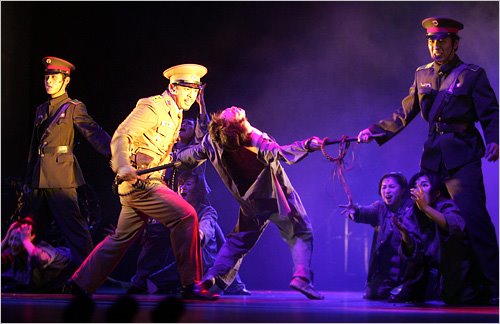 A Korean musical about human rights abuses in North Korea’s notorious Yoduk concentration camp will be staged at the National Theater in Washington D.C.
Producers of “Yoduk Story” said the musical will debut there on September 21. The 165-year old National Theater is right on Pennsylvania Avenue, about 100 m from the White House, and is one of the national symbols. There will be 10 shows until October 1 at the theater.
Suzanne Scholte, the head of the activist group Defense Forum Foundation who played a key part in arranging the show's U.S. tour, said U.S. President George W. Bush and first lady Laura Bush were invited to the premiere, although it is unclear whether the first family will attend. But she said several senators, representatives and leading figures wanted to see it.
On the eve of the first performance, a reception for the show will be held on Capitol Hill hosted by Sen. Sam Brownback, one of the sponsors of the U.S.’ North Korean Human Rights Act. Brownback also recently campaigned for six North Korean refugees to be given asylum in the U.S. The musical’s run is tipped to boost the case of hardliners in the U.S. who want to put more pressure on Pyongyang.
After the run in Washington, “Yoduk Story” will tour New York, Los Angeles and Seattle till November. The show’s director Chung Seong-san will announce the schedule next week.
[Chosun Ilbo]
Thursday, August 10, 2006
North Korea officially requests South Korean flood aid
North Korea has requested help from South Korea to cope with devastating floods, a South Korean citizens’ group said, a move that could improve inter-Korean relations chilled by the North’s recent missile launches.
It was the first time the communist nation has officially requested South Korean aid since flooding in mid-July spawned by heavy rains
The North asked South Korea to provide food, blankets, medical supplies and construction materials and equipment including cement and trucks to help it recover from the disaster, said Park Ji-yong, an official at a South Korean committee working for reconciliation between the Koreas.
A private South Korean relief group sent flood relief to the North last week.
North Korea had initially said it would handle the disaster on its own and rejected aid from South Korea’s Red Cross, but a North Korean official said the country was in urgent need of food and would accept aid from South Korea.
Seoul refused last month to discuss regular humanitarian aid during high-level talks with North Korea, after the North Koreans refused to address the country’s missile or nuclear programs.
The North has told international aid groups operating in the country that it does not want them to launch an emergency appeal on its behalf. Such aid would likely come with requirements of strict monitoring to ensure those affected are benefiting, unlike with past South Korean aid that is virtually unmonitored.
[Boston Herald]
It was the first time the communist nation has officially requested South Korean aid since flooding in mid-July spawned by heavy rains
The North asked South Korea to provide food, blankets, medical supplies and construction materials and equipment including cement and trucks to help it recover from the disaster, said Park Ji-yong, an official at a South Korean committee working for reconciliation between the Koreas.
A private South Korean relief group sent flood relief to the North last week.
North Korea had initially said it would handle the disaster on its own and rejected aid from South Korea’s Red Cross, but a North Korean official said the country was in urgent need of food and would accept aid from South Korea.
Seoul refused last month to discuss regular humanitarian aid during high-level talks with North Korea, after the North Koreans refused to address the country’s missile or nuclear programs.
The North has told international aid groups operating in the country that it does not want them to launch an emergency appeal on its behalf. Such aid would likely come with requirements of strict monitoring to ensure those affected are benefiting, unlike with past South Korean aid that is virtually unmonitored.
[Boston Herald]
Wednesday, August 09, 2006
UNICEF has difficulty raising funds for North Korea
The U.N. Children's Fund (UNICEF) is having difficulties raising funds for North Korea as international donors have been "shying away" due to the nuclear development program and missile tests by the communist state, an official at the international relief agency for children has said.
In a program of the Washington-based Radio Free Asia monitored here, Richard Bridle, deputy director of UNICEF's Regional Office for East Asia and the Pacific, said UNICEF has raised less than 10 percent of its annual target for North Korea so far this year.
"Our fundraising this year has not been good," Bridle said. "Other donors have been shying away because of political developments. It's a pity, I think, because humanitarian principals call for us not to mix politics with humanitarian needs."
Bridle, who was a representative of the UNICEF office in Pyongyang from 2001 to 2003, visited the North three weeks ago, according to the report. Bridle was concerned notably about its operation of supplying clean water for 150,000 people affected by the situation after the North's water was contaminated by the flood.
UNICEF has allocated its budget for improving prenatal health, nutrition, environment and education in the North. The North's children, who suffer from malnutrition, are smaller by about 10-15 centimeters than their counterparts in the South, according to the Unification Ministry in Seoul.
[Yonhap News]
In a program of the Washington-based Radio Free Asia monitored here, Richard Bridle, deputy director of UNICEF's Regional Office for East Asia and the Pacific, said UNICEF has raised less than 10 percent of its annual target for North Korea so far this year.
"Our fundraising this year has not been good," Bridle said. "Other donors have been shying away because of political developments. It's a pity, I think, because humanitarian principals call for us not to mix politics with humanitarian needs."
Bridle, who was a representative of the UNICEF office in Pyongyang from 2001 to 2003, visited the North three weeks ago, according to the report. Bridle was concerned notably about its operation of supplying clean water for 150,000 people affected by the situation after the North's water was contaminated by the flood.
UNICEF has allocated its budget for improving prenatal health, nutrition, environment and education in the North. The North's children, who suffer from malnutrition, are smaller by about 10-15 centimeters than their counterparts in the South, according to the Unification Ministry in Seoul.
[Yonhap News]
Subscribe to:
Posts (Atom)