Thai Prime Minister Thaksin Shinawatra has called on local authorities in Thai border provinces to take stricter measures against an influx of refugees from North Korea, the Bangkok Post reported. The embattled premier made the call while on the campaign trail to the northern province of Chiang Rai, which borders Laos, a popular route for refugees from North Korea fleeing via China.
The paper reported defection attempts from North Korea are on the rise, with 212 North Koreans arrested in Thailand since 2004. On March 19, the paper reported authorities in Chiang Rai were stepping up security measures to stop North Korean refugees crossing the Mekong River to enter Thailand illegally.
[The Chosun Ilbo]
Tuesday, March 28, 2006

Monday, March 27, 2006
Seek asylum - but where?
What's a poor North Korean refugee in China to do? Staying put, you have to hide out. Other than lie low, or return to North Korea, there are two options. One is to seek asylum in a foreign mission in China. Some years ago there was a rush of embassy incursions in Beijing, aided by activists. The lucky ones who made it eventually got to Seoul; but since then security around embassies has been tightened.
A few still succeed via this diplomatic route, but for most, the only option is to continue the journey: to get out of China into another country.
That means going either north or south: to Mongolia, or Southeast Asia. Either journey is both physically arduous and risky. A 17-year-old boy, Lee Chol-hun, who had spent half his life hiding in China, was shot - in the back, by some accounts - and killed by a Chinese border guard while trying to cross into Mongolia.
Even once over the border, the unforgiving Gobi takes its toll. Yoo Chul-min was just 10 when he perished, lost and exhausted in the desert.
The southerly route, which more take, has its own perils. You have to cross the length of China. Physically you blend in, but just hope no one tries to talk to you and twigs that you're a foreigner. Again this is costly and risky. An "underground railway" of activist NGOs may help with money and safe houses.
--Aidan Foster-Carter, honorary senior research fellow in sociology and modern Korea, Leeds University, England.
Saturday, March 25, 2006
North Korean Prison Camp: Lee-young Gahl
Lee-young Gahl used to be a famous basketball player in North Korea. He ended up in a political prison camp simply because his father was a landowner.
One day, Mr. Gahl found the ox-tail whip [that one of the guards] used to carry, soaked it in water to soften it, and ate it in secret.
When this was discovered the following day, [the guard] brutally beat him in front of all the prisoners. He then ordered the supervisor to bring squirming roundworms from the toilets, which had been put on a stick, and the heartless security officer forced it into the mouth of the helpless Mr. Gahl, who was on the ground.
That night, he ran a high fever and his body swelled up from the severe assault he had suffered. With his head on my legs as a pillow, he let out sighs saying: "Yong, all I did was inherit what my father had left me. Is it such a horrendous crime? Do I really deserve this kind of punishment?"
After three days he died.
--As related by Yong Kim, who escaped from a political prison camp in North Korea, and after living as a refugee in China, arrived safely in South Korea via China and Mongolia one year later.
Friday, March 24, 2006
Taking a position because it is right
I dedicate the publishing of these quotations to those who are giving their lives to help North Korean refugees, as well as speaking out on the atrocities of North Korea, and to all those who have taken a position to work in some way on behalf of the world’s poor and downtrodden:
"Cowardice asks the question: is it safe? Expediency asks the question: is it politic? Vanity asks the question: is it popular? But conscience asks the question: is it right?
"And there comes a time when one must take a position that is neither safe, nor politic, nor popular- but one must take it simply because it is right.” - Martin Luther King, Jr.
“Greater love has no man than this, that he lays down his own life for others.” - Jesus Christ
Thursday, March 23, 2006
Men who have laid down their lives for others
John Yoon is a 64-year-old Korean-American, Korean born. He was arrested in May 2005 while working to help North Korean refugees. He has gone to China multiple times. When the Chinese authorities arrested him they showed him three notebooks they had compiled on him and this group. He has some serious medical conditions… and winter is [upon him] in his unheated prison in northern China.
Jeffrey Park (Korean-American) fell into a river while trying to help six North Korean refugees across a river from China to Myamar, and was lost. He had given the group’s last life preserver to one of the refugees.
Choi Young-hun, a Korean, was leading a group of 5 NGOs who bought a fishing-boat. They planned to use it to ship 60 refugees to South Korea. Just days before they were going to set out, Chinese authorities arrested the group, including Choi. I don’t know how the Chinese authorities found out. Maybe they were betrayed for the bounty that Chinese authorities put on refugees and those helping them. Choi has been in prison for 3 years and is in poor health.
--An account by Tim Peters, as published in Korean Liberator
Wednesday, March 22, 2006
Suffering Chinese Christians
"They hung me up across an iron gate, then they yanked open the gate and my whole body lifted until my chest nearly split in two. I hung like that for four hours."
That is how Peter Xu Yongze, the founder of one of the largest religious movements in China, described his treatment during one of five jail sentences on account of his belief in Christianity.
China's new generation of leaders are trying to consolidate control of the country as it goes through rapid social and economic changes. China's Christian population - especially those who refuse to worship in the tightly regulated state-registered churches - is seen as a threat to this control. And this is exacerbated by the fact that the number of Christians in China continues to rise.
One high-profile case is that of Gong Shengliang, head of the South China Church, who was sentenced to death in 2001. His sentence was commuted to a prison term, but Amnesty has received reports that he has been severely tortured in jail.
Peter Xu said that while he was in jail, he saw several people even being killed for their faith.
"A believer was praying, so a jailer made other prisoners lift him up to the ceiling and drop him to the ground many times until he died," Mr Xu said.
But government crackdowns - and even torture - may not make people like Peter Xu give up their faith. "Despite all the persecution and suffering, God is calling more and more people in China," he said.
Full BBC article
Tuesday, March 21, 2006
Speaking out for the truth
Dedicated to those speaking out about the atrocities of North Korea and China, and on behalf of the downtrodden everywhere:
"First they came for the Jews and I did not speak out - because I was not a Jew. Then they came for the communist and I did not speak out - because I was not a communist. Then they came for the trade unionists and I did not speak out - because I was not a trade unionists. Then they came for me - and there was no one left to speak out for me."
- Pastor Niemoeler (victim of the Nazis)
Monday, March 20, 2006
Yodok Story: Musical about North Korean Prison Camp
Many writers have pointed out that the new show that opened in Seoul, South Korea, Yodok Story, takes on an unlikely topic for a musical: prison camps in Stalinist North Korea.
On the side of reality, the director and choreographer are North Korean -- and both were once prisoners in the vast North Korean gulag system.
Kim Young-sun, the show's 70-year-old choreographer, spent eight and a half years at the Yodok prison camp and later found out she'd been imprisoned for knowing too much about the personal lives of North Korean leaders.
The show's director Jung Sung-san, 37, also spent time inside North Korea's prisons: three months in Sariwon camp. Jung was a soldier when he was arrested. His crime?
NPR News reports, "I was caught listening to South Korean radio reports about the death of our leader Kim Il-sung," he recalls.
Choreographer Kim says the reality of life and death for families inside the vast prison camps is much worse than the musical depicts.
"I lost my parents and I lost my son as well. My son drowned. When I heard I about it, I ran about 10 kilometers home, but all I saw was his dead body. My parents starved to death. When I think about such things, what is described in the musical is nothing."
Sunday, March 19, 2006
Musical Tackles Life in North Korean Prison Camp
The director of the musical Yodok Story, Jung Sung-san, says his father was stoned to death in a prison camp, and that motivated him to press ahead with this musical. But it's been difficult.
He says the South Korean government has pressured him not to produce the show. It's attempting reconciliation with the North and is avoiding publicizing the horrors of the regime. One of the companies funding Yodok Story backed out in November 2005 because it was afraid of the South Korean government.
Choreographer Kim Young-sun says she doesn't understand why the world doesn't seem to care.
"Why is it that in North Korea there is a disaster going on, and no one knows about it? Through this art, I want people to know the reality of these prison camps. And the reality of North Korea's prison camps is that they are worse than Auschwitz."
This musical tackles the weighty themes of life and death, good and evil, ideological fervor and human love. And it ends with a Christian message of forgiveness and redemption, accompanied by the Lord's Prayer in Korean.
The director now wants to take the show to the United States. "This is my mission," he says. "I need to tell the world the truth."
[From “All Things Considered” by Louisa Lim, NPR News]
Saturday, March 18, 2006
North Koreans Refugees in New Jersey Seek Asylum
When starvation hit North Korea, Young Ae Ma watched countrymen who stole corn from fields being shot to death in public executions. On dozens of other occasions she witnessed official killings, including of friends and colleagues, for what seemed to be no reason at all.
Ms. Ma received word that she would be imprisoned or killed because she had had contact with a businessman who fell out of favor with the regime. She sought refuge in South Korea, entering by plane with a fake Chinese passport. In Seoul, she settled into a new life, performing with a dance troupe of defectors, remarrying a fellow North Korean and eventually hiring a smuggler to kidnap her son so he could join her in Seoul.
In early 2004, Ms. Ma and her husband traveled to America with a performing arts group of North Korean defectors and never used their return tickets.
Now, from her tiny home in northern New Jersey's Korea Town, Ms. Ma has launched a public campaign to pressure the American government into granting political asylum to her and her family. In doing so, she is providing a rare glimpse into the immigration challenges facing many North Korean defectors who are in the New York area illegally and avoiding the attention of authorities.
[Excerpt of article by Daniela Gerson, New York Sun]
Friday, March 17, 2006
Accepting North Korean refugees and U.S. security
Accepting refugees North Korea is a challenge because of security issues involved, but the U.S. could certainly do more to open up to them, a presidential adviser said Thursday.
Stephen Hadley, head of the National Security Council, said the issue involves a "trade-off" between opening up and helping the refugees and national security.
"You want to be open to people. You want to be open to refugees," Hadley said at a question-and-answer session with the U.S. Institute of Peace. "...at the same time, we cannot be (in) a position of letting people into our country who, at the end of the day, do harm to it," he said.
"It's a balance test," Hadley said. "And in many instances, we have not gotten the balance right.""And the president has given the Secretary of State clear guidance that one of her challenges is to relook at these things and make sure we've gotten the balance right," he said.
[Yonhap News]
Thursday, March 16, 2006
Lawmakers Frustrated about North Korea Refugee Act
It's a wait and see if there's any response. A bipartisan group of nine senior U.S. lawmakers have sent a letter to Secretary of State Condoleezza Rice, expressing frustrations with the non-implementation of the North Korea Refugee Act, and urging the administration to establish an asylum policy for North Korean refugees.
Case in point: No North Koreans have been offered asylum since President George W. Bush signed the North Korean Human Rights Act into law in October 2004.
The lawmakers also expressed alarm that the president apparently included no money for the act in his most recent budget request. The act had authorized $20 million to help North Koreans outside their homeland; $2 million to support human rights, democracy and economic reform in North Korea; and $2 million to help broadcast information into North Korea.
The State Department had no immediate comment on the letter, but Rice told Congress that her office was reviewing its policies "to see if we can find a way to participate in the refugee activities."
The letter, citing congressional testimony by humanitarian workers, said "some State Department employees at our own embassies in China, Vietnam and Thailand have actually refused to assist North Korean refugees who were at terrible risk."
In October, Timothy Peters, the founder of Helping Hands Korea, said at a hearing that U.S. Embassy officials in Beijing rebuffed him when he tried to arrange help for a 17-year-old North Korean refugee. "I thought to myself, `Is this the State Department's implementation of the North Korean Human Rights Act?'" he said.
The letter also demanded that the United States urge China to stop what lawmakers said were efforts to send North Korean refugees back to their homeland and to jail humanitarian workers.
Wednesday, March 15, 2006
North Korea Top Persecutor
For the fourth straight year, the isolated communist nation of North Korea remains atop the 2006 Open Doors “World Watch List” of 50 countries where Christians are persecuted the most. The list is based on evaluations and testimonies obtained by Open Doors’ indigenous contacts, field workers and members of the persecuted church.
It is believed that tens of thousands of Christians are currently suffering in North Korean prison camps where they face cruel abuses. Some think the hermit regime has detained more political and religious prisoners than any other country in the world.
On occasion, North Koreans become Christians after crossing the border into China as refugees and entering into contact with local Christians. Many are exposed as believers when they return to North Korea. Many face torture and death.
Due to the continuing severity of persecution, Open Doors USA has launched a Prayer Campaign for North Korea. As a member of the North Korea Freedom Coalition (NKFC), Open Doors USA is partnering with NKFC during the North Korea Freedom Week April 24-30, 2006. (To get your church involved in this event, including ordering prayer materials, contact Open Doors USA Advocacy Coordinator Lindsay Vessey at lindsayv@odusa.org. )
opendoorsusa.org
Tuesday, March 14, 2006
North Korean refugees in China
North Korean refugees in China are entirely vulnerable in China.
This fact was tragically underscored in an episode that involved the precarious fate in China of two teenaged daughters of a former military officer in the North Korean army. When the entire family of four was arrested in China and repatriated to North Korea, the father was immediately executed as a traitor without trial.
The mother was sent to a labor camp, and the two daughters (ages 14 and 17) were eventually released. The two teens showed remarkable resourcefulness by crossing to China again.
[Through the Underground Railroad network] we were able to find a shelter for the girls, however the younger of the two daughters wandered away from the safe house and was picked up by Chinese police & repatriated. The older sister is safe for now, but runs the risk of being trapped into human trafficking if not rescued soon.
I’d had high hopes that my own government (U.S.) would lend assistance, but those hopes were dashed, so options are being explored to move her along the Underground Railroad to safety.
--Tim Peters, Helping Hands Korea [Excerpts of a speech to Joint Session of NGOs and Lawmakers]
Monday, March 13, 2006
First Hand Account: Arrest and Torture
I was working in the Trade Section of the State Security Department as an agent for the West Sea Asahi Trading Company, when I was arrested in May 1993.
In a secret den in Maram of Yongsung District in Pyongyang, the police began to interrogate me. They asked me what my purpose was for entering the State Security Department and harassed me for my boldness in posing as a patriot, hiding my true identity as the son of a spy. They tortured me for answers that I had no way of giving.
The different forms of torture are too numerous to recount. Sometimes they put a wooden stick with sharp edges behind my knees, made me kneel, and then trampled my body with their heavy boots. At other times, they would hang me by the shackles on my wrists, high enough so that I was forced to stand on tiptoe. At night water would fill the solitary cell up to my stomach, depriving me of any sleep. During the long hours under water my body would gradually swell up, making it difficult for me to keep my balance. If I fell, the guards kicked me until I scrambled up again in extreme pain and fatigue.
The endless tortures were wasted on me because I could not have confessed to something I had neither done nor known. If anything I was a loyal son of KIM Il-sung and the state. Raised in an orphanage since the age of four, while other kids played in the loving arms of their parents, I was more influenced by the Party and the Great Leader KIM Il-sung than by my own parents. Naturally, I grew up to be a faithful worker whose loyalty to the Party and the Leader was impeccable.
After three months of repeated questioning, threats, and torture, I was driven five hours from Pyongyang, going through five guard posts. When I was finally let out of the car, my eyes wandered so that I could try and figure out where I was, but a quick order came from one of the men:
"Head to the ground and be still!" I complied submissively only to feel heavy boots kicking my head.
-- Yong Kim, who escaped from a political prison camp in North Korea in 1998, and 1 year later arrived safely in South Korea via China and Mongolia.
Sunday, March 12, 2006
North Korea View on Religion
Religious freedom is essentially absent in North Korea, where the government severely represses public and private religious activities.
In recent years, the government has formed several religious organizations that it controls for the purpose of severely restricting religious activities in the country. For example, the Korean Buddhist Federation prohibits Buddhist monks from worshiping at "official" North Korean temples.
Most of the remaining temples that have escaped government destruction since the Korean War are regarded as cultural relics rather than religious sites.
Similarly, the Korean Christian Federation restricts Christian activities [which begun with] wholesale destruction of over 1,500 churches during Kim Il Sung's reign (1948-1994).
[Excerpts from The U.S. Commission on International Religious Freedom (USCIRF)]
Saturday, March 11, 2006
North Korea View on Christianity
Persons found carrying Bibles in public or distributing religious literature, or engaging in unauthorized religious activities such as public religious expression and persuasion are arrested and imprisoned. There continue to be reports of torture and execution of religious believers.
Officials have arrested, imprisoned, tortured, and sometimes executed North Korean citizens who were found to have ties with overseas Christian evangelical groups operating across the border in China, as well as those who engaged in unauthorized religious activities such as public religious expression and persuasion.
Thousands of North Koreans have fled to China in recent years. Refugees who are either forcibly repatriated or captured after having voluntarily returned to the DPRK are accused of treason; those found to have had contacts with South Koreans or Christian missionaries are subjected to severe punishment, including the death penalty.
[Excerpts from The U.S. Commission on International Religious Freedom (USCIRF)]
Friday, March 10, 2006
North Korea’s Caste System
“Officials have stratified North Korean society into 51 specific categories on the basis of family background and perceived loyalty to the regime.
“Religious adherents are by definition relegated to a lower category, receiving fewer privileges and opportunities, such as education and employment.
“Persons in lower categories have reportedly been denied food aid.
“Prisoners held on the basis of their religious beliefs are treated worse than other inmates. For example, religious prisoners, especially Christians, are reportedly given the most dangerous tasks while in prison. In addition, they are subject to constant abuse from prison officials in an effort to force them to renounce their faith. When they refuse, these religious prisoners are reportedly beaten and have died following torture.”
[Excerpts from The U.S. Commission on International Religious Freedom (USCIRF)]
Thursday, March 09, 2006
North Koreans Catch Rats for Survival
Finding food in the detention settlement is an endless battle for survival. We ate whatever we could find – rats, frogs, snakes, insects, grass, beans, or corn grains found in cattle droppings.
If we were caught eating anything other than the rationed corn, we were severely punished. However, the severe beatings and punishments did not stop the prisoners from attempting to get additional food.
Catching a snake is a real fortune, like butchering a cow. If they find a snake while working, all of them work together to kill it and share it among themselves.
The great men in the settlement are those who are good at finding food or catching rats, snakes or frogs. At first, they used a lance or spear to kill the rats. But they devised all kinds of hooks to catch rats. Rats became extremely difficult to find.
Sometimes, they would [see] crows flying with a branch of corn. The prisoners would throw stones at the crows and they would drop the corn before flying away.
Those who could not find other food would often break ice in the stream to look for frog eggs.
--From an account by Ahn Hyok, Former Detention Settlement Prisoner
Wednesday, March 08, 2006
Slaves purchased from North Korea
The U.S. State Department, which last year placed China on its watch list for human trafficking, defines the practice as “modern day slavery, involving victims who are forced, defrauded, or coerced into labor or sexual exploitation.”
There are between 600,000 and 800,000 people, mostly women and children, trafficked across national borders, according to the State Department.
More than 250,000 of those victims are in China.
Slaves are also purchased from North Korea and within China and forced into manual labor.
Sen. Chuck Hagel (R-Neb.), chairman of the Congressional-Executive Commission on China, said “80 to 90 percent of the refugees from North Korea, particularly women and children end up as trafficking victims.”
[CNSNews.com]
Tuesday, March 07, 2006
The Measure of Peace
"Peace, in the sense of the absence of war, is of little value to someone who is dying of hunger or cold. It will not remove the pain of torture inflicted on a prisoner of conscience. … Peace can only last where human rights are respected, where the people are fed, and where individuals and nations are free."
- The Dalai Lama
- The Dalai Lama
Monday, March 06, 2006
The Odds of Remaining Free in China
North Korean refugees in China carry no recognized ID, remain continuously defenseless to arrest, detention, trafficking, slavery, brutality & ultimately, repatriation.
From 70 %- 95% of all North Korean women [who take refuge in China] fall into sex trafficking.
At present, 400 - 500 North Korean refugees are repatriated every week from China to North Korea.
Furthermore, the Chinese are prepared to detain & repatriate as many as 2,500 per week as the need arises.
[Excerpts of a speech to Joint Session of NGOs and Lawmakers]
Sunday, March 05, 2006
Prep for 2008 Beijing Olympics
As the 2008 Beijing Olympics approach, there is every indication that the Beijing leadership has put a priority of ridding its soil of North Korean refugees.
Tragically, however, it is not doing so by making use of the international agreements and treaties it is signatory to with the UN and UNHCR.
Instead, it is using what I call a blunt “pest removal” mechanism of blocking entrances and exits, and flushing out refugees through bribes to its own citizens, to reveal whereabouts of refugees and activists.
To accomplish this “sanitized, refugee-free” environment, China, to our understanding, has shifted the task of refugee “pest control” from its provincial law enforcement agencies to its federal internal security apparatus (the latter being much like the FBI in the US.)
[Excerpts of a speech by Tim Peters to Joint Session of NGOs and Lawmakers]
Saturday, March 04, 2006
Huge Prayer Vigil for North Korea
A crowd of 26,000, including 6000 pastors, gathered in Seoul this week to participate in a 2–day prayer vigil to pray for the persecuted of North Korea.
Besides prayer, the purpose was also to “bring awareness about the types of brutality, torture, slavery, as well as other non-humane conditions [North Koreans are experiencing] as part of their daily lives.”
[BosNewsLife]
Besides prayer, the purpose was also to “bring awareness about the types of brutality, torture, slavery, as well as other non-humane conditions [North Koreans are experiencing] as part of their daily lives.”
[BosNewsLife]
Friday, March 03, 2006
What Makes Tim Peters Tick
I am often asked; ‘Why am I, as a non-Korean, interested in North Korea human rights and refugees?’ … My deepest rooted beliefs regarding the repression of 200,000 political prisoners, including Christians, raised my Christian convictions to care.
In many ways I am ill-suited for the task of helping North Koreans. First, despite living in Korea for 15 years, I speak Korean poorly. Second, I have only been in North Korea for two days in 1999 to deliver food aid. Third, I do not have a scholarly background on North Korea. But I was moved to help by the stories of suffering in North Korea, especially orphans, and the suffering I saw among North Korean refugees that I met in China.
I think the ‘defining moment’ for me came in 2002 - I had already been involved in helping North Korean refugees. I met a 10-year-old North Korean boy named Yoo Chul-min. Read more.
--Tim Peters, Helping Hands Korea
Thursday, March 02, 2006
What Makes Tim Peters Tick (2)
[The group of North Korean refugees] trying to cross into Mongolia decided that they had no choice but to try to cross part of the Gobi desert without a guide. The group was lost for 32 hours and [a 10-year-old accompanying the team] died of exposure.
You might wonder if someone could die so quickly. People from more developed countries might have survived 32 hours in the desert in summer.
The damage of five or six years of malnutrition in North Korea had weakened [the 10-year-old] and he quickly died, when a healthier person might have lived. An entire generation has been weakened and had its intellectual capacity reduced by famine caused by North Korea’s failed economic policies.
I came to believe that I must do something to help. The real question is ‘How could you not care?’ It is a test of our humanity and, for those of faith (whether you are Christian, Muslim, Buddhist or another faith) of our fidelity to our beliefs.
--as related by Tim Peters, Helping Hand Korea
Wednesday, March 01, 2006
Tim Peters’ Mission in Life
Tim Peters, head of Helping Hands Korea, is a soft-spoken man who has taken on an imposing mission; to feed starving North Koreans. His organization also helps North Korean refugees by operating secret shelters in China and an underground railroad which helps North Koreans escape to freedom. Peters is also an advocate for the North Korean people, having testified before Congress and spoken about North Korea’s human rights crisis before numerous gatherings.
Tim Peters is a good man trying to do his best in a precarious position. As a foreigner in Korea, he is limited in the things he can say and still stay in the country. He seems to believe (rightfully, in my opinion) that his mission in directly aiding North Korean refugees is more important than calling the South Korean government to task for abandoning them.
We are all given different gifts and Peters’ greatest gift is his ability to aid North Korean refugees from South Korea and to get their stories to the outside world.
In the end, it is the Korean people who will have to demand a change in South Korean government policy.
By Andy Jackson, Korean Liberator
Monday, February 27, 2006
North Korean life is a hellish nightmare
“While [Kim Jong Il] lives like royalty in Pyongyang, he keeps hundreds of thousands of his people locked in prison camps with millions more mired in abject poverty, scrounging the ground for food. For many in North Korea, life is a hellish nightmare. As reported by the State Department Report on Human Rights, we believe that some 400,000 persons died in prison since 1972 and that starvation and executions were common. Entire families, including children, were imprisoned when only one member of the family was accused of a crime.”
-- U.S. Ambassador to the U.N. John Bolton
-- U.S. Ambassador to the U.N. John Bolton
Sunday, February 26, 2006
A starving North Korean refugee in China
 One reads a lot of reports about starving North Koreans.
How do you picture “starving’?
This woman, who had defected to China fleeing the mass starvation in North Korea, was captured by the Chinese police the day after this picture was taken.
She was later repatriated to North Korea.
She is known to have died soon afterward in a North Korean prison.
Saturday, February 25, 2006
Pitiful state of North Korean children
According to Marcus Noland’s best estimates,
37% of North Korean children under six are stunted,
23% were underweight, and
7% were "wasting" meaning they were acutely malnourished.
Because these estimates include better-fed areas such as the capital Pyongyang, these rates are likely to be much higher in the hungriest areas of North Korea's northeast.
Marcus Noland is a Senior Fellow at the Institute for International Economics
Friday, February 24, 2006
North Korean Prisoners Eat Pig Slops to Avoid Starvation
From an account by Ahn Hyok, Former Detention Settlement Prisoner
Pigs are raised in the detention settlement for security officers to celebrate the Great Leaders’ birthdays. The pigs are raised with rich slops. This was a clear case of animals being fed better than human beings.
If we were fortunate enough to have no guards around, we would sneak into pigsties to steal pigs’ slops. We always carried an empty can with us to scoop out slops from the troughs. Thus, the troughs were cleaned in a mater of seconds. When we were lucky, we drank directly from the troughs. It was a very rare occasion when we felt our stomachs full.
Sometimes, we were discovered by security officers and beaten terribly. One these occasions, we would be beaten until we released more feces than the slops we ate, and then sent to hard labor sites.
Once, we were cautioned by security officers that there was dung mixed in the slops. This did not stop us from stealing slops. When a sow was about to deliver piglets, the security officers made such a fuss and gave it rich slops including rice. What a contrast when they try hard to prevent delivery if a woman prisoner is pregnant.
Once, a calf was born at the cow farms. The prisoners killed, boiled and devoured it. The prisoners were badly beaten and sent to a permanent detention settlement with their families.
Thursday, February 23, 2006
North Korean Refugees to be Accepted to USA
It was reported by the South Korean newspaper, Chosun-ilbo, that Jay Lefkowitz, the American North Korea Special Envoy, said in an unofficial talk held with North Korean human rights organizations, “The North Korean refugees is a problem of credibility for the American government.”
In the talk held in Freedom House, a Washington-based international human rights organization, Lefkowitz suggested three goals of this year; bring out the North Korean human rights problem, active response towards the North Korean refugee problem, and urge North Korea to pursue liberalization.
The participants of the talks said, “Taking into consideration the criticisms received for taking a passive position towards providing refuge to the North Korean refugees, the US will soon start to accept North Korean refugees located in countries other than South Korea into the US. The maximum number of refugees accepted may exceed 100 this year.”
Meanwhile, despite the fact that the US North Korean Human Rights Act was enacted in October 2004, the US has not to date accepted any North Korean refugees due to identity verification issues of the defectors and opposition from local countries.
[By Yang Jung A, The Daily NK]
Wednesday, February 22, 2006
Europe Granted Asylum to 280 NK Refugees
Seven European nations have welcomed a total of almost 300 North Korean defectors since late 1990s, a U.S. broadcaster reported.
Radio Free Asia (RFA) said countries such as Germany, Britain and Denmark have issued asylum status to 280 defectors from North Korea in the past 10 years.
Germany topped the list with a total of 232 since 1995, while Britain has offered asylum to 25 defectors since 1996.
Next came Denmark with seven, followed by the Netherlands with six, Sweden with five and Norway with two.
[The Korea Times]
Monday, February 20, 2006
North Korea threatens to call off talks with South
North Korea threatened to halt talks with Seoul unless it pulls out of joint U.S.-South Korean military drills. The talks are aimed at reducing tensions between the two armies that face each other across the heavily fortified border, known as the Demilitarized Zone.
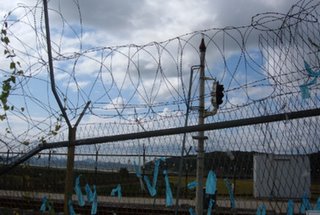 The United States has about 30,000 troops in South Korea working with about 690,000 South Korean troops.
North Korea has most of its million-strong military positioned near the Demilitarized Zone.
The two Koreas are technically still at war because the 1950-1953 Korean War ended with a truce and not a peace treaty.
South Korea is also part of separate six-country talks aimed at ending North Korea's nuclear weapons programs. Those talks have hit a snag over a U.S. crackdown on firms it suspects of helping North Korea in illicit activities such as counterfeiting.
[Reuters]
 The United States has about 30,000 troops in South Korea working with about 690,000 South Korean troops.
North Korea has most of its million-strong military positioned near the Demilitarized Zone.
The two Koreas are technically still at war because the 1950-1953 Korean War ended with a truce and not a peace treaty.
South Korea is also part of separate six-country talks aimed at ending North Korea's nuclear weapons programs. Those talks have hit a snag over a U.S. crackdown on firms it suspects of helping North Korea in illicit activities such as counterfeiting.
[Reuters]
Sunday, February 19, 2006
‘Typhoon’ Tells Story of North Korean Defector
A North Korean refugee boy, rejected by South Korea for asylum, narrowly escapes North Korean guards, who kill his parents. He grows up to become a pirate on a vengeful mission: drenching the Korean peninsula in a nuclear rainstorm.
The South Korean action film "Typhoon" strikes many viewers as implausible, but North Koreans who risked their lives escaping the communist regime know better.
"I think it's the first movie that accurately depicts the reality of North Korea," said Kang Chol Hwan, who met President Bush last year to discuss his memoir of growing up in a prison camp. "This is the true story of us. I cried throughout the movie."
"Typhoon" tells the story of Choi Myung Sin and his family, who flee to China and seek refuge in South Korea after breaking into the Austrian embassy in Beijing. Fearing a diplomatic conflict with China, South Korea rejects their asylum bid and secretly repatriates them to the North. During yet another escape attempt, Choi's parents are shot dead by North Korean guards. Choi and his older sister manage to run away, but their life in hiding means scavenging for food and the sister gets raped by a Chinese farmer while trying to steal a few dumplings for Choi.
The reality for North Koreans trying to flee the totalitarian regime is "far more tragic and tearful," said Kang, who was sent to a North Korean prison along with his family at age 9 because his grandfather was accused of anti-government activity.
[From Associated Press article by Bo-Mi Lim]
Saturday, February 18, 2006
‘Typhoon’ to hit North America
Thousands of North Koreans are said to be living in hiding in China, which is obliged to send them back under a bilateral treaty. Activists say China repatriates up to 400 defectors every week to North Korea where they can face harsh punishment.
"North Korean women, in particular, are in extreme peril in terms of being snared by human traffickers either to be sold into marriage to a Chinese person or to be pulled into the sex trade," said Tim Peters, founder and director of Helping Hands Korea, a Christian charity group supporting North Korean refugees.
Activists estimate more than 70 percent of North Korean women who try to defect become victims of human trafficking in China, while North Korean defectors say the figure is much higher, Peters said.
"Typhoon" director Kwak Kyung-taek, whose father fled the North during the Korean War, said he was trying to portray the "kind of hostility the North Koreans would harbor against South Korea" when they were sent back to their communist homeland.
So far "Typhoon" is only showing in Asia but the makers hope to distribute the film in the United States and Canada later this year.
[From Associated Press article by Bo-Mi Lim]
Friday, February 17, 2006
North Korean defectors aren’t greeted with flowers
Every year, hundreds of North Koreans fleeing hunger, poverty and oppression cross the border into China, hoping to continue on to South Korea. Beijing sees them as illegal economic migrants subject to repatriation. North Korean law mandates a minimum two-year prison sentence for those who leave.
The issue has put South Korea and China at loggerheads; meanwhile, defectors and activists contend that humanitarian issues get short shrift.
"When I came to China, I learned that people in North Korea eat worse than a pig in China," said a 34-year-old North Korean woman who revealed only her surname, Moon.
Refugees do make it to South Korea, although scenes of North Koreans being greeted with flowers don't always ensue.
A 24-year-old defector living in South Korea said escaping from China was somewhat easier than dealing with confrontational South Korean Embassy and National Intelligence Service (NIS) officials. She lived in China for several years before a failed escape attempt through Burma. Eventually, she left China and in 2002 went to the South Korean Embassy in Kuala Lumpur, Malaysia.
"We went in and sat down, and my wife just said: 'I'm a North Korean. I want to defect,'" said her American husband, who was with her at the time. "She apparently had been the first one there. They didn't know what to do."
After several frustrating days, South Korean authorities allowed them to fly to Seoul, the couple said. But when they arrived, NIS agents boarded the plane, cursing and roughing them up. "They were just totally anti-defector," said the American, who speaks fluent Korean. "It's always been that way."
Activists have tried many novel ways to get refugees out of China, from high-profile dashes using ladders to climb into embassy compounds in Beijing to desert drives to the Mongolian border to risky land routes through Burma, Thailand and Vietnam.
"New routes are being looked for all the time," said Tim Peters, the founder of Helping Hands Korea, a group that raises funds for clandestine operations to move refugees out of China. "Old routes get discovered and get shut down."
[Excerpt of an article by Jeremy Kirk, The Washington Times]
Thursday, February 16, 2006
Christianity is North Korea’s biggest fear
International fears over North Korea have centered recently on its nuclear arms capabilities, but Christian observers say the issue masks what should be another global concern--the communist nation's treatment of its own citizens, especially Christians.
Not only are millions of North Korea's citizens starving, approximately 200,000 men, women and children accused of political crimes are languishing in prison in the far northeast region. Anyone caught criticizing President Kim Jong Il is arrested and subjected to hard labor, torture, starvation, biochemical experimentation or mass execution.
Dr. Norbert Vollertsen, a German physician, traveled into the secret places of North Korea taking video and still images of the starved and dying. "Kim Jong Il does not allow any god besides him," he told Charisma. "The Christians in North Korea are eliminated--executed. Christianity is their main enemy because they know about the power of Christianity."
Tim Peters, an American missionary and founder of Helping Hands Korea has lived in South Korea for 15 years. His ministry sends food into North Korea through proven smugglers who assist the most needy. Besides its normal monthly shipments, the ministry delivered 19 tons of baby food to a northeastern province.
[From an article by Hope Flinchbaugh, Charisma Magazine]
Wednesday, February 15, 2006
Ridiculous abduction charge by North Korea irk NGOs
Members of nongovernmental organizations trying to help North Koreans who have fled their impoverished country find safe haven lashed out over Pyongyang's claim that they were kidnapping its people. During bilateral talks in Beijing that ended Wednesday, North Korea demanded that Japan hand over seven NGO members it reckoned were "abducting" its escapees.
Those sought include Lee Young Hwa, leader of Rescue the North Korean People! Urgent Action Network (RENK), and Hiroshi Kato, a senior member of Life Funds for North Korean Refugees.
"What we are doing is far from abducting," Kato told The Japan Times on Thursday. "I am displeased to be referred to as a perpetrator of such an act."
Kato stressed that his group helps North Koreans who flee to China to escape starvation in the reclusive state. The group provides food and shelter to the refugees, cares for the children they bring with them and even provides food to North Korea, he said.
"North Koreans flee their country because the North Korean government cannot feed them enough food," Kato said. "The North Korean side is just trying (to use the NGO issue) to get the upper hand in negotiations with Japan."
[Excerpted from an article by Kanako Takahara, The Japan Times]
Monday, February 13, 2006
Refugees in China Get a Helping Hand
What is it that makes a person reach out to someone they've never met before to lend a helping hand? What is it that makes a person aid others despite the presence of peril?
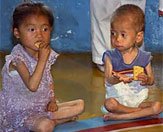 There are, of course, a number of answers - charity, goodwill, common humanity to name a few - and it's a combination of these mixed with a sense of brotherhood that is leading groups of mostly South Koreans to northeastern China to help North Korean refugees.
While it may be a Korean issue for the most part, there are others involved. One of them is Tim Peters, an American missionary playing a key role in getting the word out about what is going on and getting aid and support to those that need it most.
Peters has been involved with helping North Korean refugees since 1998 through Helping Hands Korea, a Christian mission he founded.
[Excerpt of article by Andrew Carroll, Korea Times]
 There are, of course, a number of answers - charity, goodwill, common humanity to name a few - and it's a combination of these mixed with a sense of brotherhood that is leading groups of mostly South Koreans to northeastern China to help North Korean refugees.
While it may be a Korean issue for the most part, there are others involved. One of them is Tim Peters, an American missionary playing a key role in getting the word out about what is going on and getting aid and support to those that need it most.
Peters has been involved with helping North Korean refugees since 1998 through Helping Hands Korea, a Christian mission he founded.
[Excerpt of article by Andrew Carroll, Korea Times]
Subscribe to:
Posts (Atom)