A 54-year-old North Korean refugee named Lee escaped from his country with his granddaughter. He said:
"The day I discovered that my grandsons, ages 11 and 8, were missing, ... I asked friends of my grandson where he was. They said that my grandsons [were last seen] near the black market."
The next day, Mr Lee visited the black market. There he met other parents [also searching for missing children].
They told Mr Lee that their sons disappeared at a noodle restaurant near the black market. Mr Lee reported the problem to the police department.
The police raided the noodle restaurant and found human hands and feet in a pot of kimchi (Korean pickles). Police also found human bones in a garbage pit in the backyard.
The female owner of the noodle restaurant confessed that she had served free noodles to the children and had invited them to stand by a stove to get warm. When they fell asleep, she killed them with an axe.
The murderers were publicly executed by gunfire.
Thursday, October 19, 2006

Wednesday, October 18, 2006
North Korea and the Big Question
As crude as the North Korean blast was, it punctuated a scary fact:
The rules that governed the nuclear road during the cold war and its immediate aftermath have become irrelevant, replaced by the law of the jungle--every state, rogue or otherwise, for itself.
The risk now, says former Clinton Administration Defense Department official Graham Allison, is the emergence of a more dangerous nuclear age. Pyongyang's test, says Allison, threatens to set off a "cascade" of nations seeking the ultimate weapon. "The North Korean test blew a hole in the nonproliferation regime of Northeast Asia," says Allison. "I think this is bad news for the country, bad news for the region, bad news for the world."
What are the consequences for the U.S. and the rest of the world? Are we in an era of barely controlled proliferation, in which countless nations must at least consider the possibility of going nuclear? Or are those fears, in the wake of the North Korean test, overblown? Is there still time to manage the situation?
[TIME]
Human flesh sold in North Korean markets
<> Caution: Not for the faint-hearted <>
Due to severe famines, human flesh is reportedly being sold on the black market in North Korea. Starvation in North Korea appears to have reached a point where people are abandoning their humanity.
While meat is a luxury for North Koreans, on the black farmer's market, live pigs, goats, chickens and rabbits can be found. Sometimes, pork and mutton are also available. All such meats are expensive. Only privileged people such as local executives of the governing Labour Party and high-ranking military officials, or smugglers who make money from trade with China, can afford them.
In some corners of the black market, pieces of “special meat” are displayed on straw mats for sale. People know where they came from, however, they do not speak about it. One North Korean refugee said: "Oil from animal meat coagulates and becomes round in shape, however, that of human flesh coagulates and takes the shape of a diamond."
The sale of human flesh is expanding beyond the granary regions. The same witness said,
"If a funeral takes place during the day and the burial is performed that evening, the grave may be dug open and the body stolen before morning. Such incidents happen often. The stolen body is cut into pieces and sold on the black market. This is why people conduct funerals in the evening and bury the dead bodies at midnight. Thus people cannot steal the bodies during the day because other people are watching. Also, the dead bodies lose freshness over night, which makes it difficult to market them."
Tuesday, October 17, 2006
Are the North Korean starvation stories really true?
Q: Despite reports that the North Korean people are starving, on TV I saw black markets in North Korea and it looked like they had lots of goods there. Is the starvation an exaggeration by mass media, to gain audience ratings?
A: It is true that the black markets have become more active recently, since the authorities are no longer able to keep a tight lid on them after government rations were discontinued.
It is also true that you can get anything, if you have enough money. The prices are extremely high though. The average worker's monthly salary ranges from 60 to 70 won, and this will barely buy 200 grams of rice or one pack of cigarettes.
[To illustrate the degree that famine has had on North Koreans], some years back, Life Funds for North Korean Refugees invited a North Korean resident, Mr. Kang Chul Hwan who had been in a North Korean prison camp, to lecture meetings in several places in Japan.
Kang Chul Hwan [had been] confined in a prison camp … for ten years. … When he was released from the prison camp at age nineteen, he was only 153 cm (about 5 ft.) tall and weighed only 39 kg (about 86 lb.).
In the next ten years, he grew to 173 cm (about 5.8 ft.) and his weight increased to 75 kg (about 165 lb.) This demonstrates how malnutrition can affect growth.
[northkoreanrefugees.com]
Monday, October 16, 2006
U.N.: North Korea faces hungry winter
 Millions of North Koreans face "real hardship" this winter due to cuts in food aid from foreign donors, the U.N.'s food agency said Monday, as the country sank further into isolation after its claimed nuclear test.
U.N. Security Council sanctions imposed after Pyongyang's purported nuclear test last week don't apply to food aid, which the impoverished country has relied on to feed its people for more than a decade. But South Korea, a key donor, stopped aid after the North fired a series of missiles in July, and supplies from China, the North's main foreign food donor, are one-third of last year's levels, said Mike Huggins, a WFP spokesman who just returned from a five-day visit to North Korea.
The aid shortages come on top of the North's decision to accept less food from the World Food Program. A decision that means about 4 million people fewer are being fed this year, Huggins said.
At this time of year, fruit and vegetables "are not available to the poorest people, and they become more reliant on food aid," Huggins said in Beijing. "If that food aid is not there, then there is going to be very real hardship." North Korea's grain harvests should show a shortfall of about 800,000 tons this year. WFP will donate about 75,000 tons, or less than 10 percent of the shortfall.
Huggins said children, mothers, the elderly and the infirm were at greatest risk. Some 37 percent of North Korea's children are malnourished and one-third of mothers are malnourished and anemic, he said. Huggins said those figures were likely to "look even more alarming" if more aid is not delivered soon.
The North has needed foreign donations to feed its 23 million people since its state-run farm system collapsed in the mid-1990s following the loss of Soviet subsidies.
[AP]
North Korea changed the subject for the Republicans
In one deadly moment, North Korea has succeeded in doing what no amount of backtracking by Speaker Dennis Hastert or his beleaguered Republicans could do: It has changed the subject of the national debate. With nuclear weapons in the hands of the most deranged regime in the world, e-mails to pages will have to fade from the forefront of the public’s attention.
Will Bush be able to deal with the North Korean crisis? This is truly the moment for a test of his leadership. If he is able to lead a strong global effort to face down the renegade nation and can set in motion a demonstrable process that could lead to a reversal of Pyongyang’s nuclear ambitions, he will have pulled off a coup akin to JFK’s in the Cuban missile crisis and rescued his party from midterm election defeat in 2006 as surely as Kennedy saved it in 1962.
The key, of course, is China. … China has one major fear: a regional nuclear competition with Japan. With Japanese technological prowess and the mangled history between the two nations, Beijing cannot react impassively to the nuclear arming of Tokyo.
But Bush has to produce and has to do it in the next five weeks. Just like JFK did in 1962.
[From a commentary by Dick Morris, who was an adviser to Bill Clinton for 20 years]
Sunday, October 15, 2006
Price of a broken deal in North Korea
Twelve months ago it seemed the west's nuclear confrontation with North Korea had reached an unexpectedly happy ending. In a deal brokered by China on September 19 2005, Kim Jong-il's regime pledged to give up its atomic weapons, abandon existing nuclear programmes and rejoin the UN Nuclear Non-Proliferation Treaty that it had repudiated in 2003.
In return the US agreed to recognise North Korea's territorial integrity and eschew all hostile actions. The Bush administration thereby effectively withdrew its earlier threats of forcible regime change levelled against a founder member of President George Bush's "axis of evil".
The US also promised to move towards normalised relations if Pyongyang kept its side of the bargain. It even revived the idea of helping North Korea build a light-water nuclear reactor for civilian power generation, a scheme promoted by the Clinton administration in the 1990s but later dropped by Mr Bush.
The September deal brought sighs of relief across Asia and in Washington, where rightwing newspaper editorials hailed a "triumph of US policy". It spawned talk of a new era of strategic cooperation between the US and China, a denuclearised Korean peninsula, and the peaceful reunification of North and South Korea.
But the celebrations were premature. For reasons that remain unclear, the US treasury department chose almost the exact moment the deal was struck to move against a Macau-based bank called Banco Delta Asia. US officials announced the bank could face punitive action under US banking rules and Patriot Act anti-terrorism laws over suspicions that it was being used by North Korea for money laundering and counterfeiting.
Intentionally or not, the US had dealt the Pyongyang regime a major blow that years of bilateral aid, trade and export sanctions had failed to achieve.
Apparently facing financial strangulation, Pyongyang's leadership resorted to the only diplomatic weapon it had.
[Excerpt of article by Simon Tisdall, The Guardian]
Saturday, October 14, 2006
U.N. unanimously adopts North Korea sanctions
The U.N. Security Council voted unanimously on sanctions against North Korea in response to the country's nuclear test.
Rather than mandating stop and search operations, "the resolution will say to countries to inspect as necessary all goods going in and out of North Korea," CNN's Richard Roth reported. The aim is to stop materials and technology that could be used for nuclear weapons production from going to or from North Korea.
Diplomats from the five permanent council members plus Japan gathered in closed-door meetings Saturday morning to reach agreement.
While details of the draft resolution were incomplete, diplomats said it could prevent materials for weapons programs and luxury goods from being sold to North Korea.
The language is directed at North Korean leader Kim Jong Il, who has a long, documented record of living a life of luxury while his people wasted away in famine. On Friday U.S. Ambassador to the U.N. John Bolton said, "The North Korean population's been losing average height and weight over the years, and maybe this will be a little diet for Kim Jong Il."
China has expressed concern that because the proposed sanctions fall under Section 7 of the U.N. Charter, which makes them binding on all member states, they could lead to a blockade or even military action to enforce them.
[CNN]
North Korean collapse a nightmare scenario for China
A collapsing North Korea is a nightmare China hopes will never come true, as it could lead to military and political chaos on its doorstep, analysts say.
"China is opposed to any military action against North Korea," said Cui Zhiying, director of the Center for Asia-Pacific Studies at Shanghai's Tongji University. Any abrupt, large-scale change on the Korean peninsula would go against China's overall strategy, which targets the stability required for a rapidly growing economy.
"They don't want another Iraq or Afghanistan or Kosovo on their northeastern border," he said.
"If something cataclysmic were to happen, China would have a North Korea where Japan and the United States are big players, and they don't want that.”
The risk that a war in Korea would send massive flows of refugees across the border into China tends to be overstated, and probably does not figure high in deliberations in Beijing, according to analysts. With a population of 1.3 billion, a few hundred thousand North Koreans would be "a drop in the bucket" for China. "Recall the Korean War back in 1950s. The North Koreans did not escape into China in massive numbers. They would move into the hills," he said.
Ultimately, China would hate drastic change because peaceful development of the current status quo is a much more certain road towards greater influence on the peninsula.
[Agence France-Press]
Friday, October 13, 2006
Chinese Internet intervention: North Korean refugee women
Since the passage of the U.S. North Korean Human Rights Act, a couple of lucky North Korean defectors have successfully made their way to the U.S. And with more and more choosing to make their escape from North Korea, their first stop being China, Chinese authorities have stepped up their efforts to search for North Korean refugees, who are then sentenced to severe punishment, and forcefully repatriated to North Korea.
A recent article in a Chinese online newspaper, Renmin Daily ('People’s Daily'), an offshoot of the official Chinese Communist Party newspaper, has been circulating among Chinese bloggers. The article highlights the miserable life of a North Korean female about to be repatriated to North Korea. This article has now made its way onto numerous Chinese portals and blogs reaching thousands of readers.
The article, entitled “North Korean bride in China”, calls for direct action by the Chinese people, the author highlighting the plight of North Korean refugee women who are being sold through the slave trade.
The writer’s cousin paid 10,000 yuan (US$1,264) to acquire a North Korean woman to be his wife. The author goes on to explain “The North Korean woman matched with my cousin was apprehended by authorities at the time of their wedding preparations, and was already pregnant.” He then issues an appeal for this North Korean bride-to-be who “does not want to be forcefully repatriated back to North Korea, and has not eaten for 5 days.”
Highlights of newspaper article ‘North Korean bride in China’
Friday. As usual I called home to say hello. My mother told me … many people were taking North Korean women as brides. [Those who are] unable to acquire wives [turn to] the slave trade market.
North Korean women are very beautiful, can tolerate hardship and know how to [handle] pain. They are also very affectionate to the elderly. Within a few months, they can basically learn and speak the Chinese language. … As you all know, these women do not have any legal status in the country and so it is very dangerous for them to live as illegitimate wives. However, there is great acceptance amongst the villagers. Villagers say ‘No fuss, No control,’ (If the people don’t make a fuss, then authorities won’t take control either).
However, …some people informed public officials of my cousin’s North Korean bride and she was taken away. For a village family this is a fatal blow. My mother had thought that my cousin and his North Korean fiancé would live a very happy life. Soon, they were to celebrate an official wedding ceremony and the North Korean woman was already pregnant with my cousin’s child. The moment the North Korean woman was captured by public officials she began a hunger strike.
The majority of Chinese people do not discuss political issues but rather wager their luck on fortune by trying to go and live in developed countries like the U.S. or Europe. … The reason North Koreans come to China is because they are starving. How severe must their hunger be that they cannot endure it and risk their lives by defecting out of their mother country? Also, why is it that they detest returning to their country so badly?
[Republished from the Chinese press in The Daily NK]
Thursday, October 12, 2006
Senator John McCain On North Korea
Korea doubts the world’s resolve. It is testing South Korea, China, Russia, Japan, and the United States. They launched seven missiles in July, and were criticized by the Security Council, but suffered no serious sanction.
I am encouraged by the Security Council’s swift and strong condemnation of the act on Monday, but the permanent members must now follow up our words with action. We must impose Chapter 7 sanctions with teeth, as President Bush has proposed.
China has staked its prestige as an emerging great power on its ability to reason with North Korea, keep them engaged with the six party negotiations, and make progress toward a diplomatic resolution of this crisis. North Korea has now challenged them as directly as they challenge South Korea, Japan, Russia and the U.S.
The President is right to call on the Council to impose a military arms embargo, financial and trade sanctions, and, most importantly, the right to interdict and inspect all cargo in and out of North Korea. The worst thing we could do is accede to North Korea’s demand for bilateral talks. When has rewarding North Korea’s bad behavior ever gotten us anything more than worse behavior?
[Excerpt from a post at Captains Quarter from Senator John McCain]
North Korea diplomacy “a collective failure"
In his September 9, 2006, address to the 4th Global Strategic Review of the London-based International Institute for Strategic Studies, Mitchell Reiss offered a remarkable observation:
"Perhaps the least-noted and most astonishing aspect of the entire diplomatic process involving North Korea during the past few years has been the almost complete inability of four of the world's strongest military and economic powers, including three nuclear weapons states and three members of the UN Security Council - the United States, China and Russia and Japan - to shape the strategic environment in Northeast Asia.
"They have proven thoroughly incapable of preventing an impoverished, dysfunctional country of only 23 million people from consistently endangering the peace and stability of the world's most economically dynamic region. This has been nothing less than a collective failure."
Wednesday, October 11, 2006
Nuclear blackmail and other regional fears
North Korea has repeatedly agreed to junk its nuclear weapons provided the US does three things:
1. deal directly with Pyongyang, which Washington refuses to do;
2. provide security guarantees that the US will not attack North Korea;
3. provide economic aid. The Bush Administration’s hard-line neoconservatives refuse to ‘validate’ North Korea’s totalitarian regime through direct talks.
South Korea’s biggest fears are a US-North Korean war that would devastate it; and an economic implosion of North Korea sending millions of starving refugees to south. So Seoul keeps North Korea on life support, while trying to calm American militancy.
Japan wants to deter a united Korea as long as possible, rightly fearing it would one day constitute a major economic and military threat.
One thing is clear: money, lots of it, not war, is the most effective way of making North Korea behave.
Bribery is always far, far cheaper than war.
[Excerpt of an article by Eric S Margolis, a veteran US journalist and contributing foreign editor of the Toronto Sun]
Tuesday, October 10, 2006
Realities of going to war with North Korea
A senior US State Department official warned, "we are not going to accept a nuclear North Korea." But that, of course, is just what Washington has been doing ever since CIA disclosed in 2003 that North Korea had up to five operational nuclear weapons, and more in development.
In 2005, CIA’s then director, George Tenet, confirmed North Korea’s Taepo-dong ICBM was theoretically able to deliver a nuclear warhead to North America.
The Pentagon estimates that a US invasion of North Korea would cost 500,000 American casualties. Since North Korea has buried many vital industries and military facilities deep underground, US air strikes would have limited success.
Moreover, any attacks on North Korea would quickly make South Korea and Japan targets of North Korea’s medium-ranged missiles. Seoul’s ten million people are within range of North Korean long-ranged artillery and missiles batteries behind the DMZ.
Amid all the international hysteria over North Korea, it’s important to understand that the ‘Dear Leader’s’ nuclear programs are primarily defensive. Their goal is to protect North Korea from a long-feared US attack, not to attack the US or Japan. Kim Jong-il and his Politburo are not anxious to commit suicide or see their nation vaporised.
[Excerpt of article by Eric S Margolis, a veteran US journalist and contributing foreign editor of the Toronto Sun.]
North Korean thinking on nuclear arms
The point is not whether one agrees or not, but the insight that can be gained as to the reasoning and "rationale" presented by Kim Myong Chol, the “unofficial” spokesman of Kim Jong-il and North Korea, writing in the Asia Times, a condensation of which appears below:
The North Korean nuclear test … carries five messages.
1. Kim Jong-il is the first to equip Korea with sufficient military capability to take the war all the way to the continental US.
2. The sole reason for the development of nuclear weapons is more than 50 years of direct exposure to naked nuclear threats and sanctions from the US. The Kim administration seeks to commit nuclear weapons to actual use against the US in case of war, never to use them as a tool of negotiations. The US, Russia, China, the United Kingdom, France, India, Pakistan and Israel conduct numerous nuclear detonation experiments in legitimate exercise of their sovereignty.It is sheer illusion to think that sanctions and isolation will stop North Korea from the planned nuclear test. US hostility, threats and sanctions are the very engines that have propelled the development of nuclear weapons.
3. Nuclear-armed North Korea will be a major boon to China and Russia. The two countries are friendless in case of war with the US.
4. The main enemy to North Korea is the US, the sole surviving superpower in the world. North Korea does not care at all whether Japan goes nuclear, or that South Korea and Australia follow suit. Their becoming nuclear powers will signal that the US is no longer a reliable cop. At long last de-Americanization of the US allies and neutralization of the US in the rest of the world will be set into motion.
5. Had the Americans been steadfast in upholding the nuclear Non-proliferation Treaty by reducing their nuclear weapons and respecting the sovereignty and independence of the non-nuclear states, North Korea would not have felt any need to defend itself with nuclear weapons. A nuclear test by North Korea will go a long way toward emboldening anti-American states around the world to acquire nuclear weapons. There is a long line of candidate states.
Monday, October 09, 2006
North Korea's nuclear program through two Administrations
North Korea's nuclear program has been a problem for US presidents going back to Reagan, and the conflict between North and South has been a key issue for US presidents going back to Truman. As recently as 1994, the US came far closer to war with North Korea than most Americans realize.
President Clinton eventually concluded a complicated and multipart agreement in which the North Koreans would suspend their production of plutonium in exchange for fuel oil, help building light water nuclear reactors (the kind that don't help making bombs) and a vague promise of diplomatic normalization.
President Bush came to office believing that Clinton's policy amounted to appeasement. Force and strength were the way to deal with North Korea, not a mix of force, diplomacy and aide. And with that premise, President Bush went about scuttling the 1994 agreement, using evidence that the North Koreans were pursuing uranium enrichment (another path to the bomb) as the final straw.
All diplomatic niceties aside, President Bush's idea was that the North Koreans would respond better to threats than Clinton's mix of carrots and sticks.
Then in the winter of 2002-3, as the US was preparing to invade Iraq, North Korea called Bush's bluff. And the president folded.
Threats are a potent force if you're willing to follow through on them. But he wasn't. The plutonium production plant, which had been shuttered since 1994, got unshuttered. And the bomb that exploded [this past weekend] was, if I understand this correctly, almost certainly the product of that plutonium uncorked almost four years ago.
Hawks and Bush sycophants will claim that North Korea is an outlaw regime. And no one should romanticize or ignore the fact that it is one of the most repressive regimes in the world with a history of belligerence, terrorist bombing, missile proliferation and a lot else.
But facts are stubborn things. The bomb-grade plutonium that was on ice from 1994 to 2002 is now actual bombs.
[Excerpts of an article by Josh Marshall]
North Korea says nuclear test successful
North Korea said Monday it had performed its first-ever nuclear weapons test, setting off an underground blast in defiance of international warnings and intense diplomatic activity aimed at heading off such a move.
An official at South Korea's seismic monitoring center confirmed a magnitude-3.6 tremor felt at the time North Korea said it conducted the test was not a natural occurrence. Australia also said there was seismic confirmation that North Korea conducted a nuclear test.
The North's official Korean Central News Agency said the underground test was performed successfully. "It marks a historic event as it greatly encouraged and pleased the ... people that have wished to have powerful self-reliant defense capability," the KCNA statement said.
The U.N. Security Council is expected to discuss the reported North Korean test on Monday, and the United States and Japan are likely to press for a resolution imposing additional sanctions on Pyongyang.
[Associated Press]
Sunday, October 08, 2006
Patriotic, loyal North Koreans no longer so
Until the 70-year-old North Korean woman was stripped, beaten, and charged with dissent, Park and her family were patriotic, loyal, ordinary. They were true believers in the ruling Kim family's "juche" ideology, which holds that Korea must be separate from all nations and that total obedience is owed to the Kim family. Mrs. Park's eight kids worshiped Kim Il Sung, the "father of their minds."
Yet today Mrs. Park (not her real name) is in South Korea, an escapee. Her family is broken. So are her ideals. She's been captured in China - sent home to the North, made to endure camps, and witness horrific acts.
The Park family left North Korea for China in 1999, when they got too weak to work. "I had the feeling if we didn't leave North Korea right away, we would die. I didn't leave out of disloyalty to [North Korean leader] Kim [Jong Il]. I left for the family."
Back in the North, Park expected only a rebuke. Instead, the family went to an interrogation center for 18 days, then 22 days at a police camp. The camp separated "political" from "ordinary" criminals. At every step the Parks were beaten and suffered torture designed to "break" them.
Park was told to strip her clothes in a large yard. She thought the police were looking for weapons or contraband. But it was money they wanted. Along the border Koreans hide money in body cavities. Prisoners had five rules: Work from 7:30 to 7:30. When not working, sit on your knees. Keep your head down. Never move, not a finger, or you will be hit. Finally, confess your mistakes constantly. "We were told to say over and over, 'I am sorry, I am sorry for what I have done.' "
Park eventually escaped to Seoul via an underground Christian group. Today she leads a refugee group for women. She is implacably opposed to the Kim regime. "I complain when Kim tests these useless missiles while we in the millions are poor, having nothing. This is something unforgivable."
[Christian Science Monitor]
Saturday, October 07, 2006
Insights to the North Korean Military
With reports of 60 shots being fired Saturday along the heavily armed no man's land separating the divided Koreas, this seems like a fitting time to touch on the North Korean military.
Following are highlights of a testimony by Han Young Jin, who defected from North Korea:
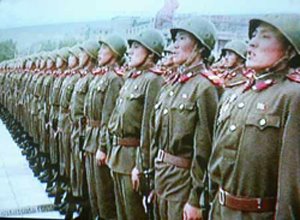 The combined North Korean military numbers 1.2 million, army, naval and air force, though some estimate the number as being closer to 1.7 million.
Military duty is compulsory: For men, it’s 10 years, and for women, it is 6~8 years.
Men used to be required to be taller than 148cm (4’10”) and heavier than 48kg (106 lbs). Nowadays they only have to be 145cm (4’9”) and 40kg (88 lbs).
This is because in the 1990s, many were stunted from lack of food. Many soldiers were at one time “kotjebi” (child beggars)”, wandering around in search of food.
Malnutrition is still a problem for those in the military. Before the food shortage, 800g of rice, and 200g of meat was the official amount provided for one day. For over ten years now, this has not been the case.
However, when it is announced that a military base will be receiving a visit from Kim Jong Il, vegetables and meat are borrowed from nearby villages for "food inspection", and later returned.
Following are highlights of a testimony by Han Young Jin, who defected from North Korea:
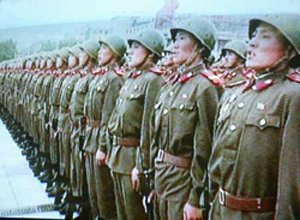 The combined North Korean military numbers 1.2 million, army, naval and air force, though some estimate the number as being closer to 1.7 million.
Military duty is compulsory: For men, it’s 10 years, and for women, it is 6~8 years.
Men used to be required to be taller than 148cm (4’10”) and heavier than 48kg (106 lbs). Nowadays they only have to be 145cm (4’9”) and 40kg (88 lbs).
This is because in the 1990s, many were stunted from lack of food. Many soldiers were at one time “kotjebi” (child beggars)”, wandering around in search of food.
Malnutrition is still a problem for those in the military. Before the food shortage, 800g of rice, and 200g of meat was the official amount provided for one day. For over ten years now, this has not been the case.
However, when it is announced that a military base will be receiving a visit from Kim Jong Il, vegetables and meat are borrowed from nearby villages for "food inspection", and later returned.
Kim Jong Il meets with his military commanders
This weekend is the anniversary of North Korean leader Kim Jong Il's appointment as head of the Korean Workers' Party in 1997.
With tensions rising, Kim met hundreds of his top military commanders and urged them to bolster the nation's defenses, the North's official Korean Central News Agency reported earlier Friday. Officers greeted him with rousing cheers of "Fight at the cost of our lives!"
North Korean state television showed still photos of the bouffant-haired leader waving to an assembled crowd of about 500 olive-suited officers in dress caps. Kim later posed for a group photo with his commanders in front of Pyongyang's sprawling mausoleum for his father and national founder, Kim Il Sung.
The meeting was the reclusive leader's first reported appearance in three weeks and the first since Tuesday, when his government shocked the world by announcing plans to test a nuclear device on its way to building an atomic arsenal.
It was unclear when the rally took place, or how many attended, but it could show that Kim is trying to polish his credentials with the military at a time when international pressure is mounting on Pyongyang.
[Associated Press]
Friday, October 06, 2006
North Korea believes bomb will deter US attack
While the rest of the world looks to Beijing to stop North Korea from exploding a nuclear bomb, a leading Chinese analyst says it is too late - China cannot act without doing worse harm to its own interests.
[North Korea] "considers its national interests to be greater than its relations with China," says highly regarded Shen Dingli, of Shanghai's Fudan University, in his remarkably frank commentary, circulated yesterday by a North Korea-focused think tank, the Nautilus Institute.
South Korea and China redoubled their efforts to persuade Washington to agree to separate, bilateral talks with the Kim regime, in order to secure its agreement to return to the six-party discussions it has boycotted since November.
An economic and security chaos accompanying a regime collapse is the most feared scenario in Beijing and Seoul.
In the UN Security Council, China resisted a condemnatory statement against Pyongyang's test threat because, Chinese ambassador Wang Guangya said, "if the six-party talks cannot do anything about it, I don't think the council is in a position (to do anything)".
In Mr Shen's analysis, North Korea now believes it needs to test a bomb because that will unmistakably demonstrate its nuclear capability which, in turn, will deter the US from any attack.
Mr Shen argues that the North Koreans are prepared to weather deeper trade and financial sanctions from the US, Japan and other Western countries because they believe that ultimately, the Americans will have to accept their nuclear-state status, as happened with India and Pakistan.
[The Australian]
North Korea Warned on Weapon Testing
The Bush administration delivered a secret message to North Korea warning it to back down from a promised nuclear test, and it said publicly that the United States would not live with a nuclear-armed Pyongyang government.
North Korea "can have a future or it can have these weapons. It cannot have both," Assistant Secretary of State Christopher R. Hill said in remarks at Johns Hopkins University's U.S.-Korea Institute. It was the toughest response yet from the Bush administration, coming two days after Pyongyang announced plans to conduct its first nuclear test.
Hill did not explain how the administration would respond to a test, but he said it is willing to sit with North Korean officials and diplomats from the region to discuss the crisis. "We will do all we can to dissuade [North Korea] from this test," he said. State Department officials said Hill is considering a trip to Asia to discuss options with key allies.
He said the United States had passed along a private warning through North Korea's diplomatic mission to the United Nations in New York.
North Korea is believed to have enough plutonium for as many as 11 nuclear bombs. It announced in February that it had succeeded in building a weapon, although intelligence analysts believe it is still years away from being able to deliver one.
[Excerpt of an article by Dafna Linzer, Washington Post]
Thursday, October 05, 2006
Thought on North Korea Vowed Nuclear Test
An interesting post from Donald Gregg, a CIA official since 1951, and a liaison to President Carter's National Security Council and National Security Advisor to Vice President George H.W. Bush, as well as U.S. ambassador to South Korea from 1989 to 1993. Mr Gregg is now chairman of the board of the Korea Society. In response to a Korea Liberator post on Washington Post's PostGlobal site, Mr Gregg writes:
My impression of the North Korea statement was how carefully it was was worded, and how free of bombast it was. It sounds as though North Korea is trying to establish its credentials as a responsible nuclear power.
It may hope that this statement will put pressure on the US to start talking with them bilaterally. This will not work with the Bush administration, and the gulf of suspicion and mutual hostility will only widen. I still believe that North Korea would rather talk seriously with the US than to conduct a nuclear test, but this latest move is another step away from dialogue toward greater estrangement.
Is there anything that could be done to stop a test from occuring? I think there is.
If the Bush administration would appoint a senior policy director for North Korean issues, as Congress wants it to, I believe that talks could be re-started. I fear that there is very little chance of this happening. I hope I am wrong, but I do not think I am.
Wednesday, October 04, 2006
North Korea Vows First Nuclear Test
North Korea announced today that it plans to conduct its first nuclear test, sharply escalating its standoff with the United States and setting off ripples of alarm in Japan and South Korea.
A statement released by the North Korean state-run news agency declared that “the U.S. extreme threat of a nuclear war and sanctions and pressure” compel the country “to conduct a nuclear test, an essential process for bolstering nuclear deterrent, as a corresponding measure for defense.”
Until now, North Korea has never acknowledged having nuclear weapons, although intelligence officials have assumed for several years that it had produced enough plutonium to build a bomb. Analysts have said in the past that a test could destabilize the balance of power in the region, perhaps pushing Japan to develop its own nuclear weapons, and could raise the risk of a military clash between North Korea and the United States.
The statement gave no indication of when such a test might occur. Last month, Kim Seung Kyu, director of South Korea’s National Intelligence Service, told his country’s parliament that North Korea is capable of conducting an underground nuclear test at any time.
American officials have said that if North Korea were to conduct nuclear tests, the United States would seek Security Council sanctions through a procedure that carries the threat of military action.
[Excerpt of an article by Choe Sang-Hun (Seoul) and John O’Neil (New York), The New York Times]
US Aid to North Korea if "transparent distribution"
The U.S. Agency for International Development (USAID) is reportedly willing to provide food aid to North Korea if it guarantees transparent distribution.
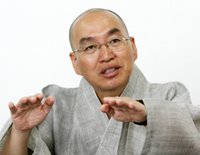 Buddhist Priest Beobryun who chairs the domestic North Korean aid agency Join Together Society met with senior U.S. intelligence official Joseph DeTrani in the U.S. last week to brief him on flood damage in the communist state.
Calling the damage the worst in North Korean history, Beobryun said that recovery is impossible without outside help.
He quoted State Department officials as expressing willingness to offer large-scale food aid to Pyongyang if it's distributed transparently in line with American law.
The Agency for International Development is an independent U.S. agency that serves as the focal point for U.S. overseas assistance efforts, with guidance from the State Department.
[KBS Global]
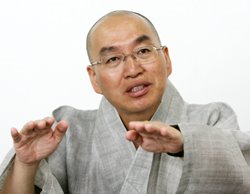 Buddhist Priest Beobryun who chairs the domestic North Korean aid agency Join Together Society met with senior U.S. intelligence official Joseph DeTrani in the U.S. last week to brief him on flood damage in the communist state.
Calling the damage the worst in North Korean history, Beobryun said that recovery is impossible without outside help.
He quoted State Department officials as expressing willingness to offer large-scale food aid to Pyongyang if it's distributed transparently in line with American law.
The Agency for International Development is an independent U.S. agency that serves as the focal point for U.S. overseas assistance efforts, with guidance from the State Department.
[KBS Global]
Tuesday, October 03, 2006
North Korean refugee children
During the past four or five years, I have met probably one hundred people who have escaped from North Korea. Some of them … are children repeatedly crossing the border.
These children repeatedly crossing the border are in tragic condition. For example, a 20-year-old boy looks like he is only 15 years old, or a 17-year-old boy looks only 11. A 16-year-old girl who looked 11 didn't even know about menstruation. Her classmates and seniors looked like they had completely stopped growing.
One 10-year-old girl had crossed the border fifteen times. … If they are arrested, they are beaten and threatened, even tortured. One boy was attacked by a thief who left a sword scar on his face.
We clothed those children, who had neither underwear nor socks, and who had no alternative but sleep in open fields in temperatures of -30 degrees centigrade (-22 degrees Fahrenheit). We also bathed them (most looked like they had not bathed for five years, judging from the thickness of their grime). They had never seen shampoo. We fed them, and interviewed them to find out how their parents had died or been killed.
We found how limited our options were for helping those children; we could do nothing but shed helpless tears for the tragic circumstances of these children.
[Source: northkoreanrefugees.com]
Monday, October 02, 2006
An increase of wandering vagabonds in North Korea
[Beginning September 6th, I] traveled throughout the Sino-North Korean border area and met several North Korean residents who came to China.
In interviewing them, I [became aware of the] North Korean people’s complete loss of confidence on Kim Jong Il, especially since the missile launch incident, recent floods, and weakened Sino-North Korean relationship.
Most North Korean residents are despairing from a decade long famine and hopeless lives. … Interviewees agreed that North Korean society was doomed to collapse because of widespread corruption and starvation.
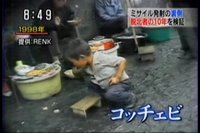 According to them, after the huge floods in July and August, the number of vagabond childrens increased. And adult wanderers volunteer to collect foodstuff on the street since it is even harder to work and earn money.
In interviewing them, I [became aware of the] North Korean people’s complete loss of confidence on Kim Jong Il, especially since the missile launch incident, recent floods, and weakened Sino-North Korean relationship.
Most North Korean residents are despairing from a decade long famine and hopeless lives. … Interviewees agreed that North Korean society was doomed to collapse because of widespread corruption and starvation.
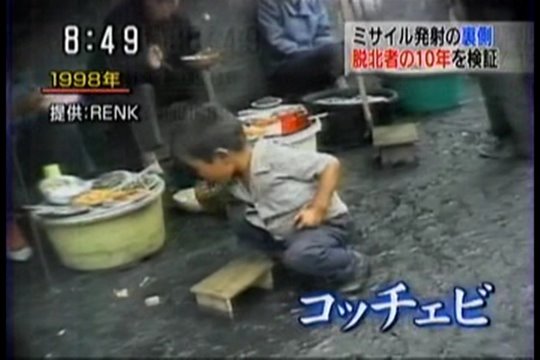 According to them, after the huge floods in July and August, the number of vagabond childrens increased. And adult wanderers volunteer to collect foodstuff on the street since it is even harder to work and earn money.
[Excerpt of an article by Choi Jeon Ho, Defector from North Pyongan province, writing in Daily NK]
More North Korean adults and children on the move
I met Choi, a 45-year-old North Korean resident in my recent trip to northeast China, in a border area in Changbai County.
Choi said that not only the number of beggar children [spiked after the July and August floods in North Korea] but also adult vagabonds increased, as it did in 1997 at the peak of the Great Famine.
The number of young wanderers, called ‘kotjebi’ (begging children), had been anticipated [but] it was the unprecedented that adult wanders appeared in such a large scale.
 Choi concluded that being a wanderer is better, if not only the only way to survive, abandoning homes and occupations [in the trade-off].
Choi stated, “Although the state has never declared that it will not provide food rationing, people no longer believe in state rationing. Workers don’t expect salaries from their companies. Nobody asks for overdue payment. They just gave up any hope on that. Since there is no ration and no salary, there is no need to keep homes and jobs.”
[Excerpt of article by Choi Jeon Ho, Defector from North Pyongan province, writing in Daily NK]
Choi said that not only the number of beggar children [spiked after the July and August floods in North Korea] but also adult vagabonds increased, as it did in 1997 at the peak of the Great Famine.
The number of young wanderers, called ‘kotjebi’ (begging children), had been anticipated [but] it was the unprecedented that adult wanders appeared in such a large scale.
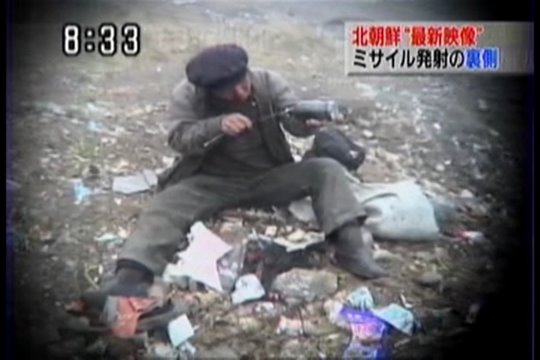 Choi concluded that being a wanderer is better, if not only the only way to survive, abandoning homes and occupations [in the trade-off].
Choi stated, “Although the state has never declared that it will not provide food rationing, people no longer believe in state rationing. Workers don’t expect salaries from their companies. Nobody asks for overdue payment. They just gave up any hope on that. Since there is no ration and no salary, there is no need to keep homes and jobs.”
[Excerpt of article by Choi Jeon Ho, Defector from North Pyongan province, writing in Daily NK]
Sunday, October 01, 2006
More on Rick Warren going to North Korea
Interesting insights into Pastor Rick Warren, who expects to be preaching in North Korea next year:
Interviewer: You've been criticized for your plan to preach in North Korea next year. The concern is that the Koreans will use you for their own purposes. How do you respond?
I'm not a politician. I'm a pastor. I don't make decisions based on politics.
If I'm not limited [by the North Koreans] in what I can say, I'll preach the good news of the Gospel. Next year is the 100th anniversary of the Pyongyang revival, and for some reason the leader [Kim Jong Il] decided to allow the first public preaching of the Gospel in 60 years. So when they invited me, I said, "Sure!"
Here are people who have been told for 60 years that there is no God, there is no purpose for your life.
Hey, I'm happy to go in there. There's risk, but I'm willing to take it.
Interviewer: But not everyone in the evangelical world seems happy about your choices, particularly your involvement in combating AIDS.
I'm kind of in a no-man's land, where I take heat from every side.
If I go to the International AIDS Conference, there are those there who want to validate their lifestyle, and I'm not going to do that. And there are others who want me to condemn everyone and not show up.
So, yes, you get misunderstood sometimes. That's just par for the course.
[Excerpt from Dallas Morning News interview]
Saturday, September 30, 2006
Korean Bar Association on North Korea human rights
The Korean Bar Association yesterday released a report on the human rights situation in North Korea, after two years of data collection and interviews with 100 North Korean defectors who came to the South after 2000.
According to the report, 90 percent of those surveyed said the North Korean law enforcement authorities do not abide by legal processes in arresting suspects or detaining them in jails.
About 22 percent of them experienced or heard from others that the authorities do not allow suspects to sleep during investigation, while 21.1 percent said torture was widespread. Some 17 percent directly or indirectly experienced abusive language and sexual harassment during investigation, and 17.5 percent underwent investigation for more than two months without an arrest warrant.
Prison inmates also usually suffer from torture and maltreatment, including abusive language, sexual harassment and beatings. Political offenders face compulsory labor 12-15 hours a day, according to the report.
In the case of female inmates, 57.7 percent of the defectors said they saw or heard that pregnant women were forced to have abortions.
Some of the surveyed also testified about illegal public executions.
The association has published reports on South Korea’s human rights every year since 1989, but this is the first time that it has released one on the North.
[Excerpt of a article by Kim Rahn, The Korea Times]
Friday, September 29, 2006
China Cracks Down
The five-year filmmaking ban imposed by Chinese authorities on director Lou Ye [for a love story set during the 1989 Tiananmen demonstrations] is just the latest signal from Beijing that its tolerance for even minor signs of dissent has shrunk dramatically. The last 18 months have seen a growing number of arrests, detentions, prison sentences and other measures apparently aimed at heading off greater freedom of expression, not just in the arts, but in religion, the Internet and both the foreign and state-run media.
Blind public interest lawyer Chen Guangcheng found himself on the receiving end of a four-year, three-month sentence last week. He was charged with obstructing traffic and damaging property. Chen, who is best known for his work on behalf of women forced to undergo abortions or sterilizations. Chen has repeatedly angered local party officials in Linyi, particularly through his revelations about the forced sterilization program.
Recent months have also seen a tightening of control over religious affairs. In early July, respected preacher and religious activist Zhang Rongliang was jailed for seven and a half years on a pointedly non-religious charge: forging a passport. Later the same month, 82-year-old underground Catholic bishop Yao Liang was arrested along with another priest, according to Catholic activists. And on July 29 the resort city of Hangzhou was the site of what some witnesses call the biggest confrontation between security forces and Christians, a bloody clash over the demolition of a church involving thousands of protesters and police.
China watchers remain divided about just how centrally coordinated such actions are. Some speculate that China's President Hu Jintao is putting on a show of strength to bolster his relatively weak grip on the reins of power; the crackdown is seen as clearing the decks of potentially embarrassing dissenters before Beijing hosts the Olympic Games in the summer of 2008. The Chinese authorities are particularly sensitive to media coverage in periods leading up to major events like the Games.
Whatever the reasons behind them, though, there is little doubt that the jailings and other measures are having a chilling impact. "Of course it makes us scared," says one Christian who witnessed the clash at Hangzhou. "We call it killing the chicken to scare the monkey. They are using us as an example so that other Christians in the rest of the country are obedient."
[Excerpted from TIME Asia]
Thursday, September 28, 2006
Personal note from Tim Peters re: North Korean Underground Railroad
We just wrapped up a summit meeting of Underground Railroad activists, gathering folks from a number of countries.
So Japanese and Korean leaders, as well as a top underground Chinese church leader, etc. were able to brainstorm new strategies as the Chinese continue to crackdown with the runup to the Olympics approaching.
General consensus was that our meetings were fruitful. and that by the grace of God!
A rep from DC attended several hours of our meetings and gave a speech to us, and then had to listen to us (courteously-ha!) lambast the US diplomatic missions abroad for their over-caution in implementing the NKHR Act on the ground in tougher environments, e.g. Laos, Vietnam, Cambodia, and of course, China.
On other fronts, I just returned from the Lao-Thai border a week back, assisting in the successful rescue of 7 North Korean refugees. [See BBC television coverage on this, "Escaping from North Korea", at the following URL: http://search.bbc.co.uk/cgi-bin/search/results.pl?tab=all&go=homepage&q=North+Korean+refugees&scope=all&Search.x=26&Search.y=9 ]
North Korea says U.S. is not world's "religion judge"
North Korea hit back on Wednesday to U.S. charges that it suppresses religion by telling Washington to stop acting as the world's "religious judge."
The U.S. State Department, in its annual International Religious Freedom Report released this month, quoted defectors and others as saying North Korea imprisoned and executed people who tried to practice religion.
An article on Wednesday in Pyongyang's official Rodong Sinmun daily said: "The U.S., after the September 11 incident, has murdered many Muslims in cold blood in its mainland, Afghanistan and Iraq and made no bones about insulting and overriding Islam and Islamic culture.
"The United States is not a 'religious judge' but a chief culprit in the repression and extermination of religion which should be put in the dock of a religious trial," Rodong Sinmun said, according to an authorized translation.
Reclusive North Korea, which governments and human rights groups say has one of the worst rights record in the world, bristles at any criticism of how it treats its citizens.
"They (U.S. leaders) hold heretical a religious view and religion which criticize or disapprove of the American way of life," said the article carried by the official KCNA news agency.
This is the latest in a long string of mutual recriminations between the two countries which remain technically at war half a century after the 1950-53 Korean conflict ended in an inconclusive truce.
[Reuters]
California minister wants to preach in North Korea
The California pastor who authored the best-selling book, "The Purpose Driven Life," wants to take his ministry to North Korea.
The Reverend Rick Warren leaves for Korea this week, with stops first in South Korea to meet with government and church leaders. Then he plans to speak to U-S troops stationed near the D-M-Z, before crossing the border to meet with North Korean officials.
A spokesman says Warren is hoping to preach next spring at a stadium in North Korea's capital to commemorate the 100th anniversary of an earlier Christian revival in Pyongyang.
The State Department estimates that out of North Korea's population of 23 million, only about 14 thousand are Christian. The department also cautions that people involved in unsanctioned religious activities in the communist nation risk arrest.
[AP]
Wednesday, September 27, 2006
98% of North Korean defectors observed public executions
A defector-based movement Free North Korea Broadcasting (FreeNK) conducted a telephone survey [of North Korean] defectors over the age of 20 years. The broadcast revealed that 98% of participants in the survey had witnessed public executions.
According to FreeNK, 49% of participants had witnessed public executions 6~10 times, 27% of participants 10~20 times and 6% of participants had witnessed public executions on more than 20 occasions. Taking the results of the survey into consideration, it can be deduced that on the greater part, that the majority of North Korean citizens have witnessed public executions.
Survey respondents revealed that murder and theft was the major crime committed by offenders, particularly during the food crisis in the mid-90’s where theft of daily necessities was most high. FreeNK further revealed responses by participants that “Stealing rice or corn, cross-handling electricity lines and slaughtering of cows served as the greater examples of crime.”
Kim a female defector from Pyongyang revealed “Even if crimes are petty, the government still sentences people to public execution as an example to those who commit crime."
[The Daily NK]
Tuesday, September 26, 2006
North Koreans in S. Korea protest over forces plan
A group of 30 former North Korean soldiers who defected to South Korea have staged a protest against Seoul's plan to revise its military alliance with the United States. The defectors said President Roh Moo-Hyun was underestimating Pyongyang's military threat in his drive to regain wartime control over his country's military.
Seoul is in talks with the United States to regain wartime operational control over South Korean troops by 2012, a major change in their alliance which dates back to the 1950-1953 Korean War.
The protesters warned against North Korea's military, which they said possessed the nuclear and chemical warfare capability to annihilate South Koreans.
"What the North Korean forces most fear is the 'South Korea-US combined forces command' troops, especially the US firepower. As long as the US forces exist, Kim Jong-Il cannot even dream of a provocation," it said.
Some 29,500 US soldiers are now deployed to help 650,000 South Korean troops face up to the North's 1.2 million-strong army.
[AFP]
Monday, September 25, 2006
Helsinki Process for North Korea Human Rights
An international conference on North Korean human rights, to look for solution through the Helsinki Process, will be held on September 26 in Washington D.C. by Freedom House, a U.S. based human rights organization.
In 1975, the United States, along with the Western European countries, and the Soviet bloc signed on an agreement in Helsinki Finland, and the western world urged the communist countries to improve democracy according to the agreement. Helsinki Process means such multilateral pressure toward democracy and human rights.
In the conference, 23 scholars from the U.S., Japan, South Korea, and China will join to discuss various solutions, especially through security, economy and human rights that are the core of Helsinki Process, of the North Korean issue. Senator Sam Brownback (R-Kansas), who led legislation of North Korean Human Rights Acts, is scheduled to have an opening speech. Sen. Brownback has been arguing for the change of course in American policy on North Korean toward Helsinki Process.
Jae H. Ku, director of the Human Rights in North Korea Project in the Freedom House, said in an interview with Radio Free Asia that there was an increase of opinion in the U.S., particularly on Capitol Hill, to apply the Helsinki Process-type solution in North Korea.
[The Daily NK]
Sunday, September 24, 2006
Seoul sets condition for resumption of aid to North Korea
South Korea's Unification Minister Lee Jong-seok said his country would resume humanitarian assistance for North Korea as soon as it returns to international negotiations over its nuclear ambitions. This is the first time the minister has explicitly offered to resume the assistance in return for Pyongyang's return to the stalled talks.
Seoul suspended shipments of its regular humanitarian aid, which included rice and fertilizer, to the North shortly after the communist state test-fired seven ballistic missiles in early July.
Pyongyang has been refusing to return to the nuclear talks, also attended by South Korea, Japan, China, Russia and the United States, since November, citing what it claims to be U.S. hostility toward its regime.
Washington wants to maintain or increase pressure on the communist state so the North has no other option but to return to the negotiating table, while Seoul wishes to lure it back to the talks through carrots.
"The United States cannot feel the same about North Korea as South Korea does because South Korea faces 1.1 million North Korean troops only 40 kilometers (from its capital) while the United States is thousands of kilometers away," Lee said.
[Yonhap News]
Saturday, September 23, 2006
North Korean refugees released in Thailand
A group of 159 North Korean defectors who fled oppression from the communist country, and were detained in Thailand a month ago, have been freed and will soon be allowed to leave the country, a U.N. official said.
According to Kitty Mckinsey, a spokesman for the Bangkok office of the United Nations High Commissioner for Refugees (UNHCR), the North Korean defectors, who were arrested in Thailand late last month for illegal entry into the Southeast Asian country, are taking necessary procedures to leave for a third country.
The spokesman did not elaborate on whether the third country was South Korea but noted that he hopes that they could leave for a third country as soon as possible.
A South Korea official, declining to be named, said that the Seoul government is willing to help those defectors come to South Korea if they want, adding that its basic stance is to respect their opinions.
According to Seoul's Unification Ministry, a growing number of North Koreans are defecting to South Korea. A total of 1,054 North Koreans have found their residence in the South in the first seven months of this year, up 60 percent from the same period of last year.
[Yonhap News]
Subscribe to:
Posts (Atom)